There’s someone in the chair.
Look toward the left side of the Combermere Abbey library photograph. Past the furniture, a pale head and the suggestion of shoulders occupy a seat that was supposed to be empty. You can lose the figure if you glance away. Then you see it again.
The story attached to that chair is worse. Its owner was being buried a few miles away while the camera sat there gathering light.
That’s one photograph. I’ve got twelve more. A woman in white who a famous scientist swore had stepped out of a séance. Searchlights piled on top of each other over wartime Los Angeles. Four bright lights hanging over a Coast Guard station in Salem. A mesa on Mars that looks so much like a face that people have been arguing about it for fifty years. A rectangular boulder standing like somebody set it there on purpose. Bundles of D.B. Cooper’s ransom money, rotting in a riverbank.
These aren’t all unsolved, and I’m not going to pretend they are. Some were later explained. Some are disputed. One was probably an animal on a crate. I’ll give you the official line when there is one. Then I want to stay with what the camera actually caught, because looking at these pictures, I keep coming back to the same feeling: something real got onto the film.
1.Lord Combermere’s Ghost
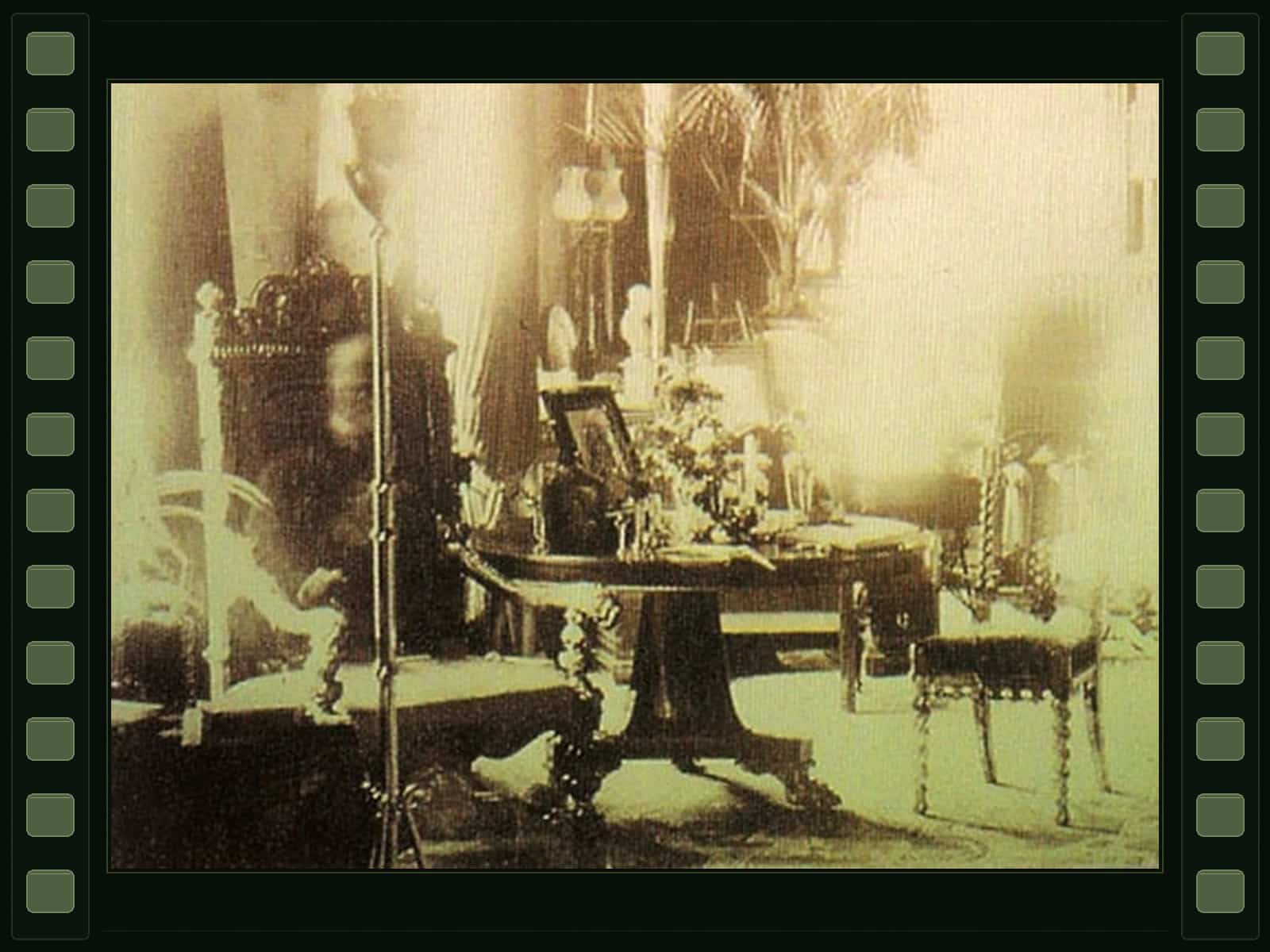
On December 5, 1891, Sybell Corbet photographed the library at Combermere Abbey in Cheshire, England. The exposure lasted roughly an hour. According to the estate, the second Lord Combermere’s funeral was happening that same day, a few miles away, and most of the family and staff were gone with it.
When the plate was developed, a faint seated figure was sitting in his chair. The family thought it looked like him. The estate still identifies that seat as his favorite. I mean, sit with that for a second. His chair. His funeral. A transparent man who wasn’t supposed to be in the room.
The official-enough explanation is the long exposure itself. If somebody sat in that chair for only part of the hour, they could register as a ghost on the plate. In 1921, C. Vincent Patrick and W. Whately Smith described William Barrett reproducing that kind of effect. That’s a workable photographic account, and I’m not going to pretend it isn’t.
What it doesn’t do is tell us who sat down, or why the people who knew Lord Combermere thought they were looking at him. A servant wandering through can explain the blur. It doesn’t explain the recognition. That’s the part that still gets under my skin.
Sources: Wikimedia Commons image record; the estate’s account; 1921 discussion of the long-exposure effect.
2. Katie King
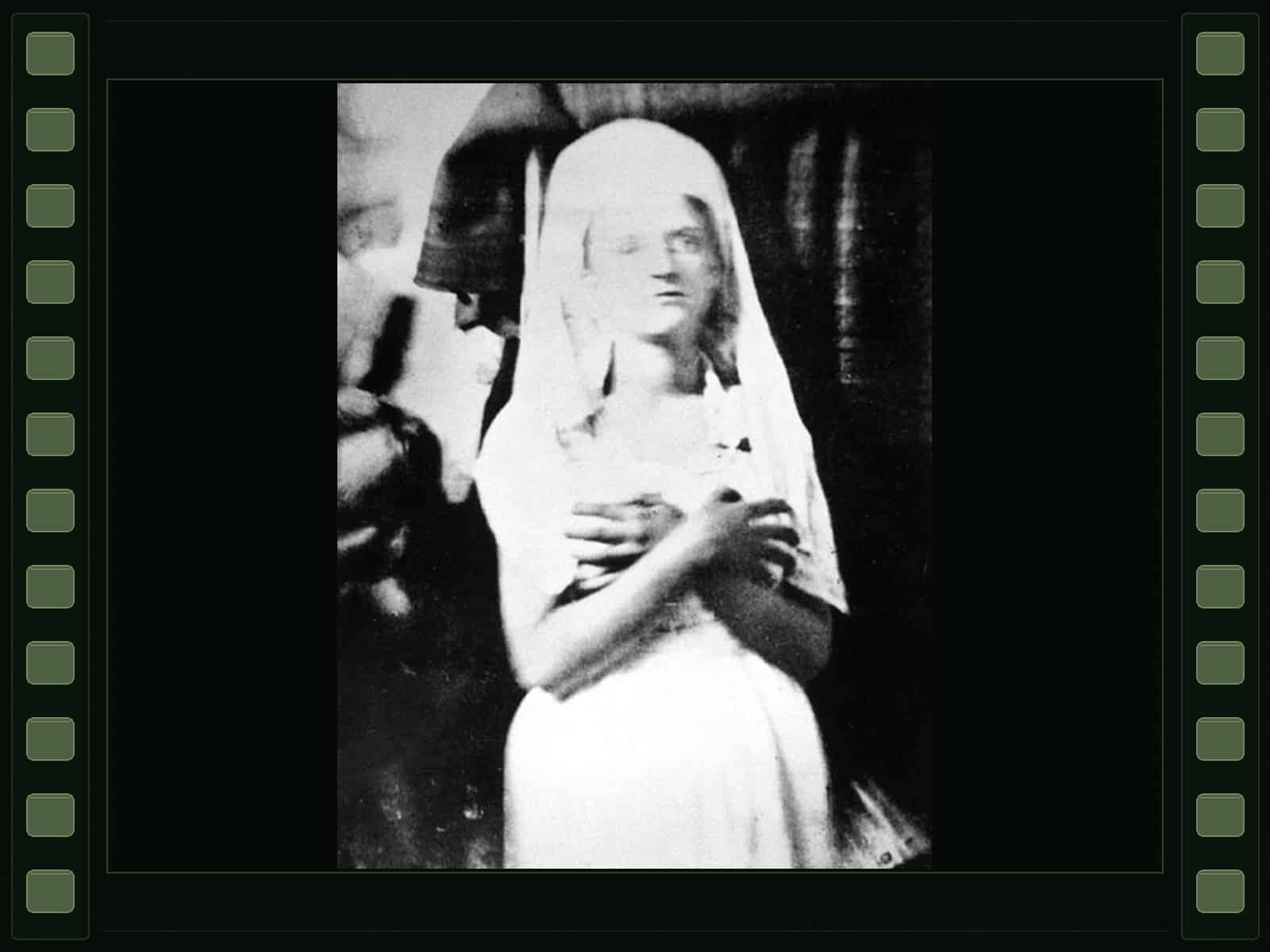
This one doesn’t hover in the corner of a parlor portrait. She takes up the frame. A woman in white, veil around her head, hands folded, looking like she just walked into the room.
In the early 1870s, the chemist William Crookes photographed what he believed was a spirit named Katie King during séances with the young medium Florence Cook. He published the work in 1874 in the Quarterly Journal of Science. This wasn’t a hobbyist with a cloudy plate. Crookes put his name, in print, on the claim that something had appeared in front of his camera.
The official line, and you’ll hear it every time this picture comes up, is that Katie King and Florence Cook were the same woman. A costume. A trick of the séance room. That’s the skeptic’s story, and it’s been the mainstream story for a long time.
Here’s what I can’t quite shake. Crookes wasn’t guessing from across the room. He photographed her. He stood beside her in other frames. He wrote it up for a scientific journal. Whatever you think Katie King was, he thought he had watched a spirit take form and he was willing to say so in public. Look at her face in that veil and tell me that photograph doesn’t still ask the question he thought he’d answered.
Sources: Wikimedia Commons image record; William Crookes, “Notes of an Enquiry into the Phenomena called Spiritual during the Years 1870-1873,” Quarterly Journal of Science, January 1874.
3. The Mount Washington UFO
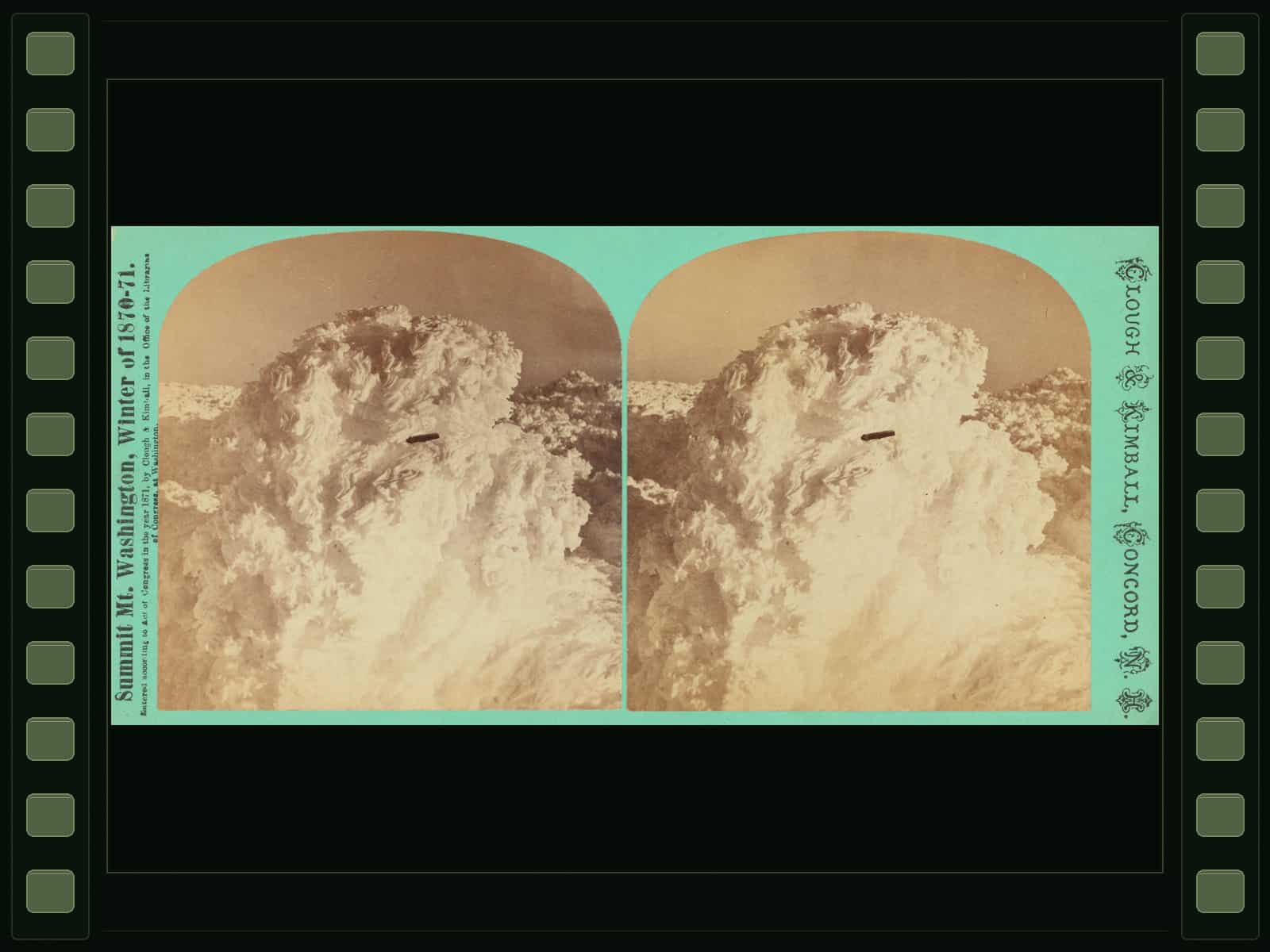
This stereograph was made in the winter of 1870-71, on the summit of Mount Washington in New Hampshire. Clough & Kimball called the series “Frost Architecture,” and you can see why. The rime ice turns the buildings into something out of a fairy tale.
Look closer, though. Against that frozen architecture there’s a dark, elongated shape, a kind of dash or rod that doesn’t quite behave like the rest of the frost. The card shows it in both panels. People who collect early anomalies sometimes call this the earliest UFO photograph.
The cautious reading is the obvious one: a cloud, a smear of snow, some trick of the winter air. I’m fine saying that out loud. It’s a stereograph of frost, not a report of a craft buzzing the summit.
And yet there it is, stamped into a commercial view card more than a decade before anyone was talking about flying saucers. Two eyes, two nearly identical scenes, and that same dark mark hanging in the cold. I keep coming back to how long this thing has been sitting in the picture, waiting for someone to notice it.
Sources: Wikimedia Commons image record.
4. The Battle of Los Angeles
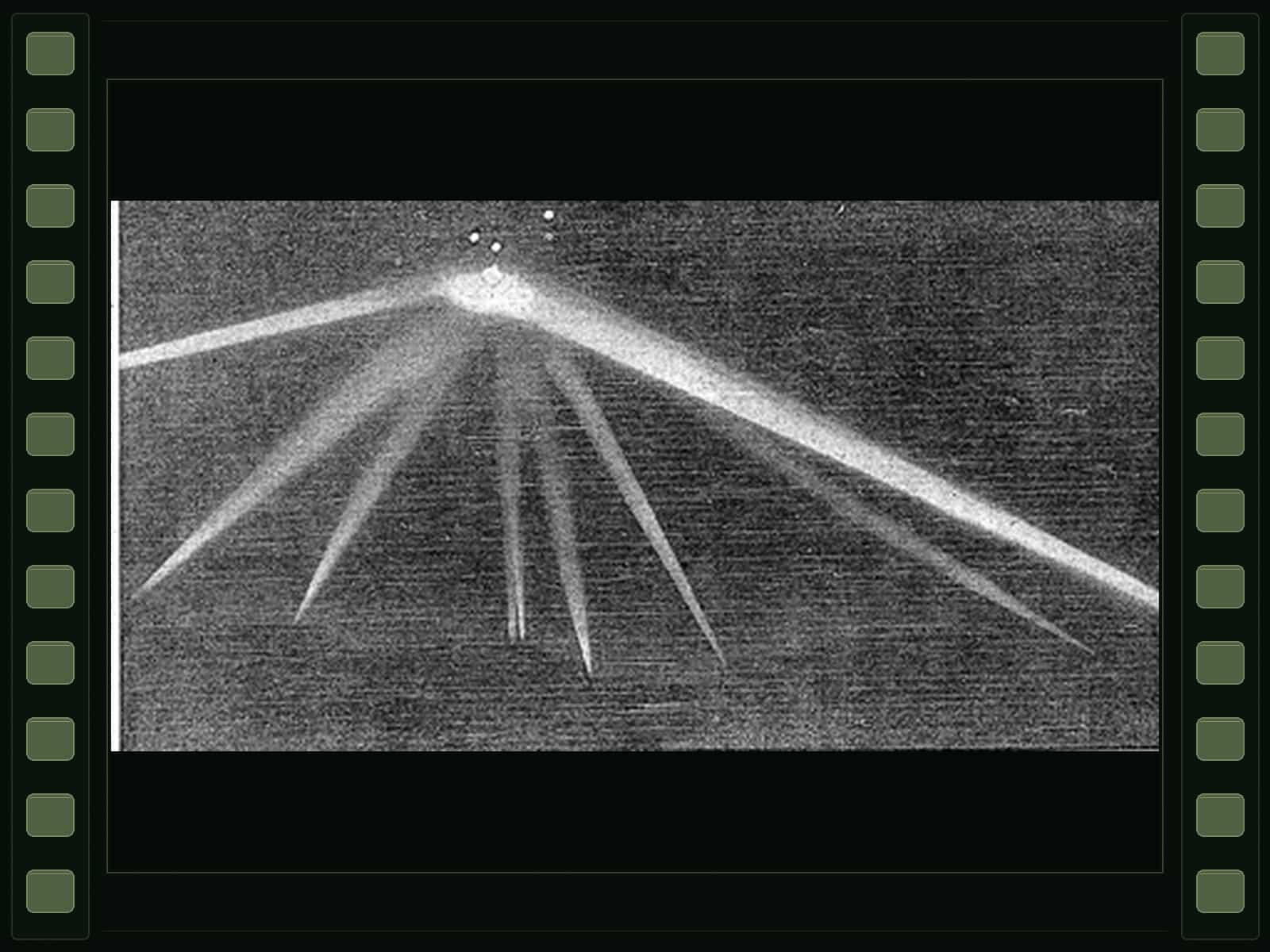
On the night of February 24-25, 1942, Los Angeles lit up the sky. Searchlights swept in from every direction. Anti-aircraft guns opened up. This was barely three months after Pearl Harbor, and only a day after a Japanese submarine had shelled the California coast. The city thought something was overhead, and it spent hours trying to knock it down.
The photograph that went out to the public ran in the Los Angeles Times on February 26. You know the one. Beams stacked on top of each other, meeting at a bright knot in the dark. That’s the image here, taken from that newspaper page.
I should be straight with you about the print. The newspaper version was retouched. The object at the center was made to look more solid than it did on the original negative. That’s how this picture first traveled, and it matters.
What the military said afterward is that they found no enemy aircraft. Wartime nerves. A false alarm. Maybe a balloon. That’s the official line.
What the photograph still shows, even allowing for the retouching, is a city that believed something was up there long enough to fill the night with searchlights and gunfire. Thousands of people watched those beams converge. The paper wanted you to see an object in the middle. I’m less interested in the airbrush than in why so many people, on edge and wide awake, thought there was something worth aiming at.
Sources: Wikimedia Commons page for the February 26, 1942 Los Angeles Times.
5. The Salem Coast Guard UFO
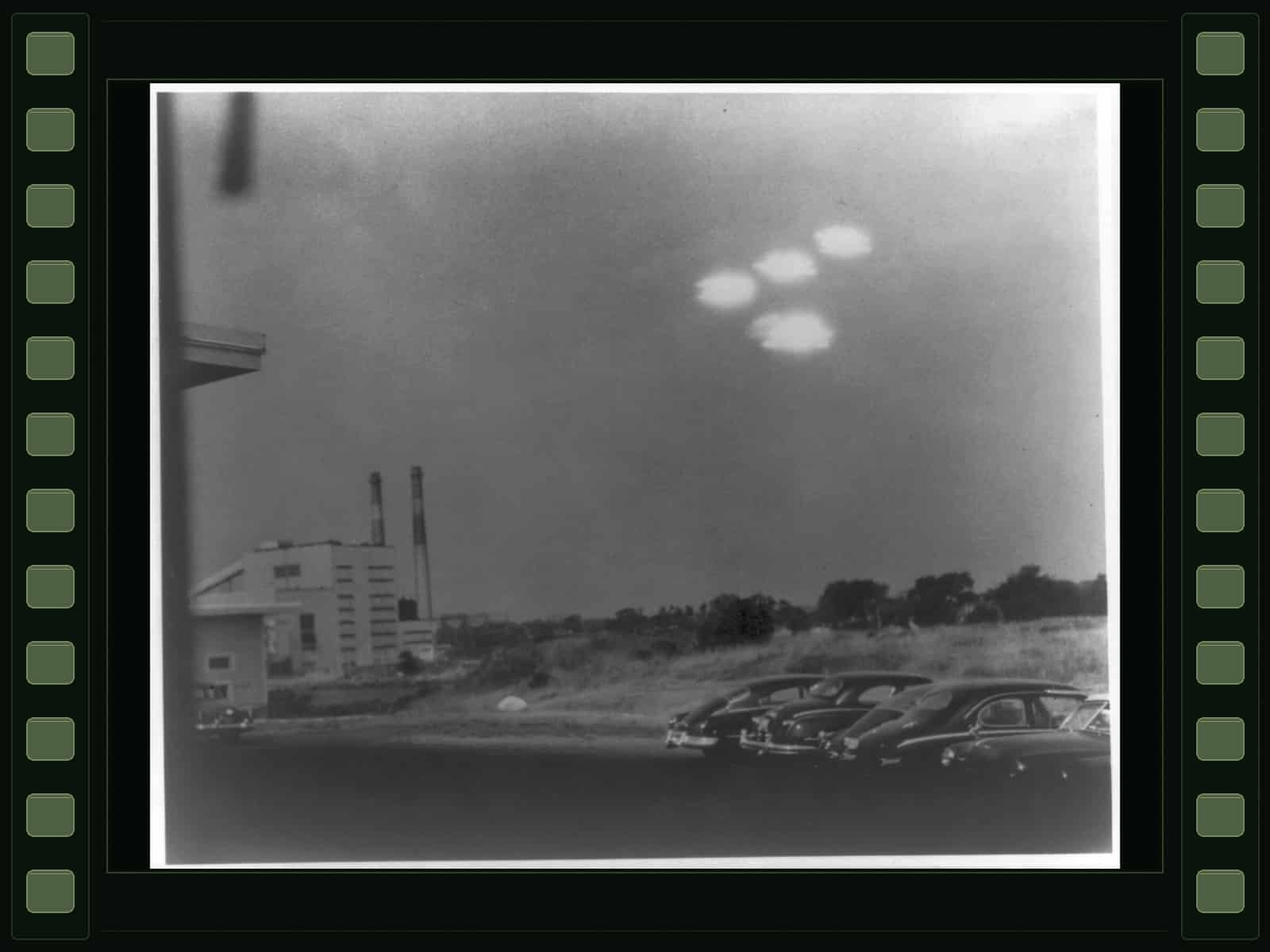
At 9:35 in the morning on July 16, 1952, Coast Guard photographer Shell R. Alpert was at the air station in Salem, Massachusetts. He took a picture through a window screen and caught four bright, roughly elliptical lights hanging over the waterfront in a kind of V.
The Library of Congress still files this one under a title I love: “First daylight photo of – what are they?” It’s official Coast Guard photo 5554. This wasn’t a tourist with a shaky hand. This was the station photographer, on duty, making a record.
Project Blue Book took a look. Researchers who have gone through that file, carried as case 1501, say it was first called a probable double exposure, then probable reflections of lights on the glass. Then it landed in the unidentified pile anyway.
So yes, he shot through a window. Yes, reflections get mentioned. I’m not hiding that. I’m also not pretending that an on-duty Coast Guard photographer’s official print, four lights over a recognizable shoreline, is easy to wave away. Blue Book had more than one chance to close it, and the case still ended up unexplained. What do you think he was looking at through that screen?
Sources: Library of Congress record.
6. The Black Knight Satellite
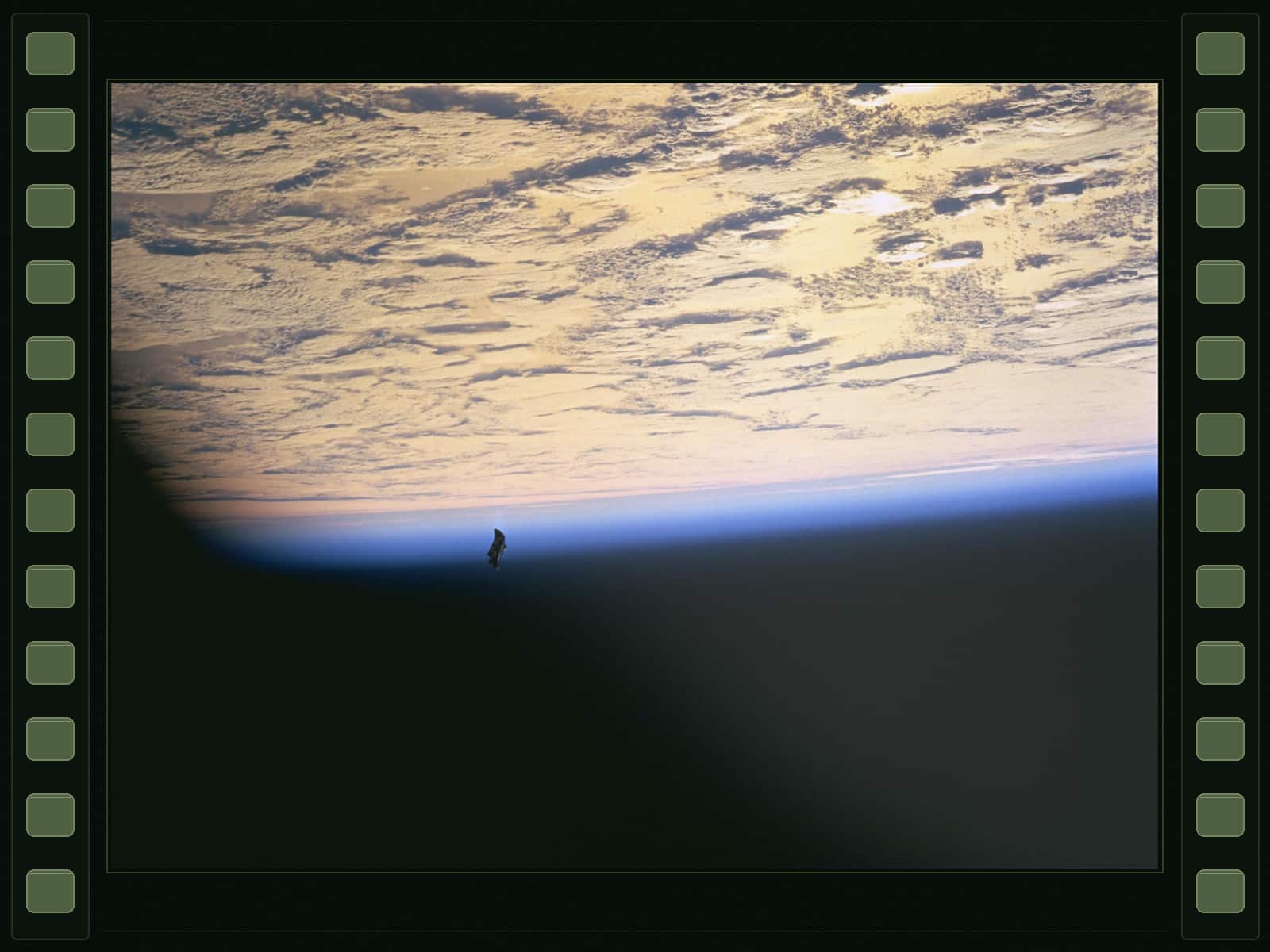
There’s a long story in ufology about something called the Black Knight, an alleged alien satellite that’s supposed to have been circling Earth for a very long time. This photograph is how a lot of people first met that story visually.
The picture itself is real. It was taken during space shuttle mission STS-88 in December 1998. In the frame, an angular dark object hangs above the blue limb of the Earth, sharp against the clouds. It does not look like a tidy piece of hardware. It looks like a jagged little craft that wandered into the shot.
NASA’s identification is debris from that same mission, usually described as a thermal cover lost during work on the station. That’s the official line, and I want you to hear it clearly: this is not confirmed proof of an ancient alien satellite.
But look at the silhouette. You can understand, instantly, why this frame got pulled into a much older legend. The object is genuine. The photograph is genuine. The story that attached itself to it is older than the shuttle flight. I don’t need this to be an ancient alien probe to find it strange that a piece of lost equipment would look this much like something built to be out there.
Sources: NASA Earth Observations catalog entry for STS088-724-66; Wikimedia Commons file.
7. The Face on Mars
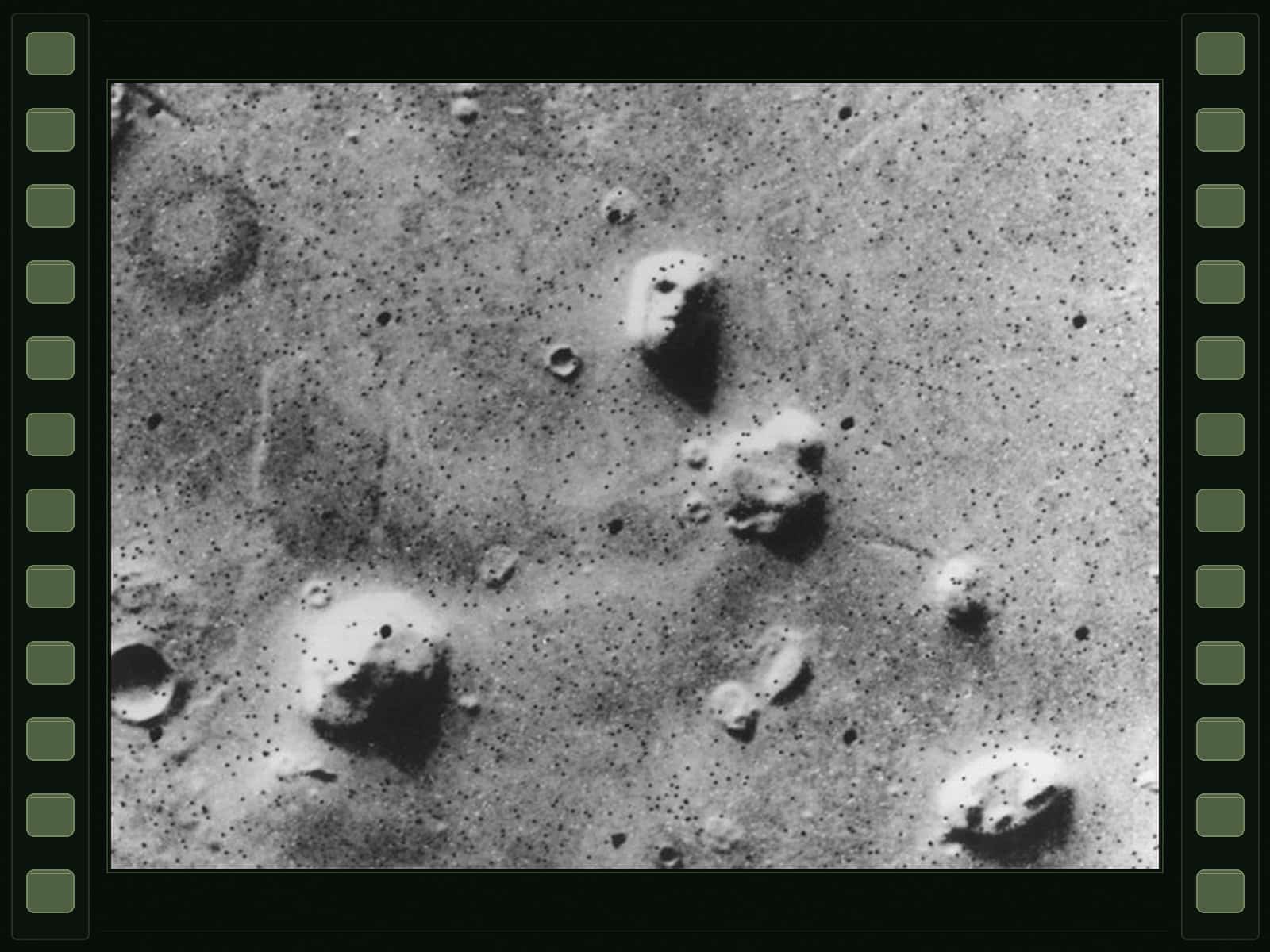
On July 25, 1976, Viking 1 photographed a mesa in the Cydonia region of Mars. In that first widely shared frame, the thing looks like a face. Not a vague maybe-face. A huge human face staring up from another world, with a brow, a mouth, the whole arrangement.
I remember how this one landed. You didn’t need a caption. Your eye did the work instantly.
Later missions went back with sharper cameras. NASA says those images show an ordinary eroded landform, and that the “face” depended heavily on lighting and the limits of that first picture. The little black specks in the Viking frame are data errors from the transmission, not holes in the surface. That’s the official explanation.
I always come back to the first look, though. Of all the mesas on Mars, this is the one that greeted us like it had been waiting. Later photos changed how a lot of people talk about it. They didn’t erase the fact that the very first time we saw Cydonia clearly enough to argue, it looked back.
Sources: NASA Photojournal PIA01141; Wikimedia Commons file.
8. The Mars Monolith
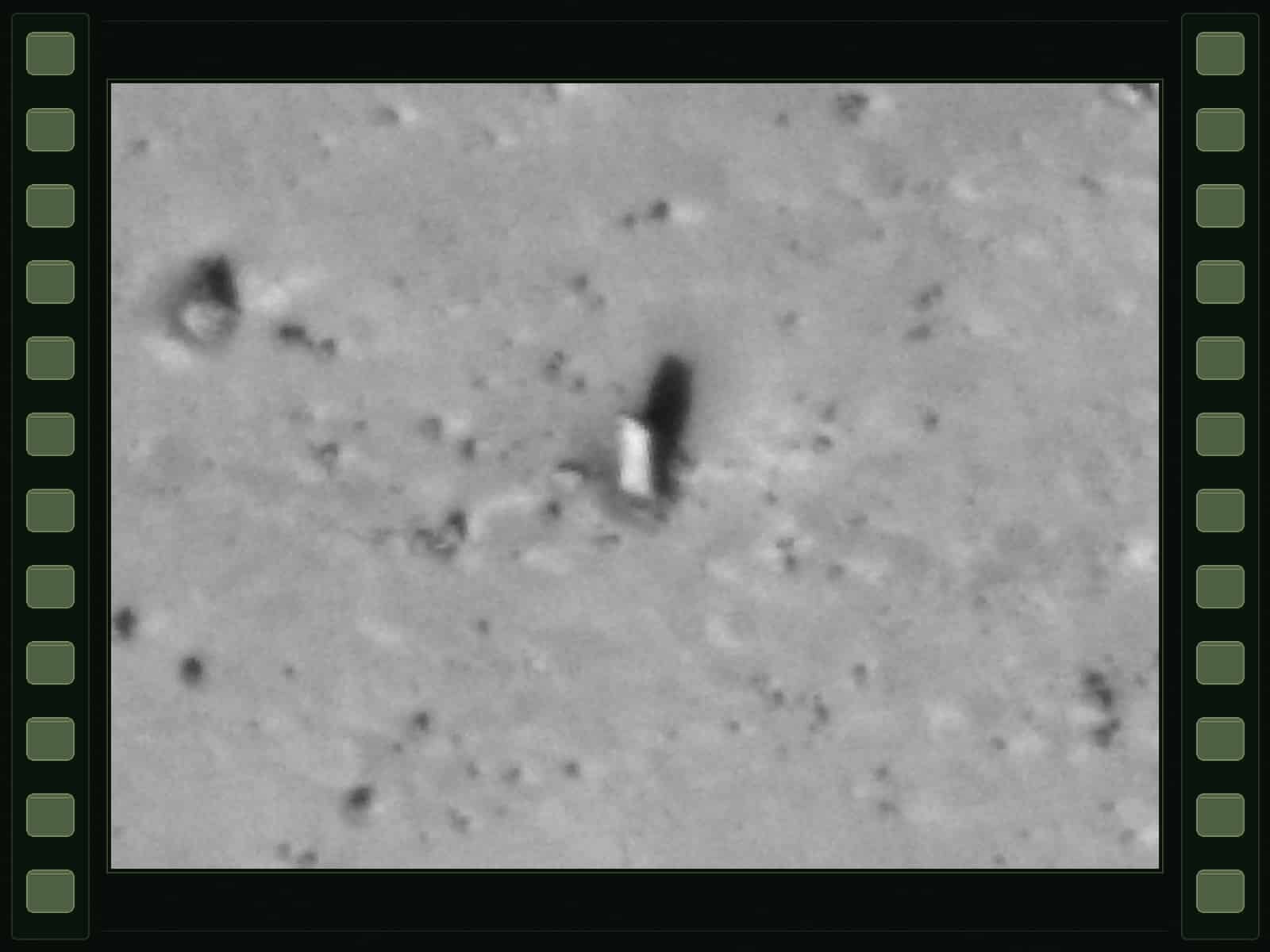
From orbit, Mars has a rectangular boulder that looks almost planted. It stands brighter than the ground around it and throws a long, clean shadow, the way a standing stone would if someone had set it upright.
NASA and the researchers who study these images call it a naturally occurring boulder. Not a monument. Not a marker left for us. Just rock, shaped by whatever Mars does to rock.
I’m willing to say that once. Nature makes strange geometry. I’ve seen enough of this planet’s own cliffs to know that.
Then I look at it again. The edges are too tidy. The stance is too vertical. It has that slightly wrong quality that makes people stop scrolling. If you dropped this frame into a folder of ancient Earth sites, a lot of viewers would assume they were looking at something placed on purpose. That’s why it got the name monolith, and that’s why I can’t quite file it next to any other loose stone.
Sources: HiRISE PSP_009342_1725; Wikimedia Commons crop.
9. The Phobos Monolith
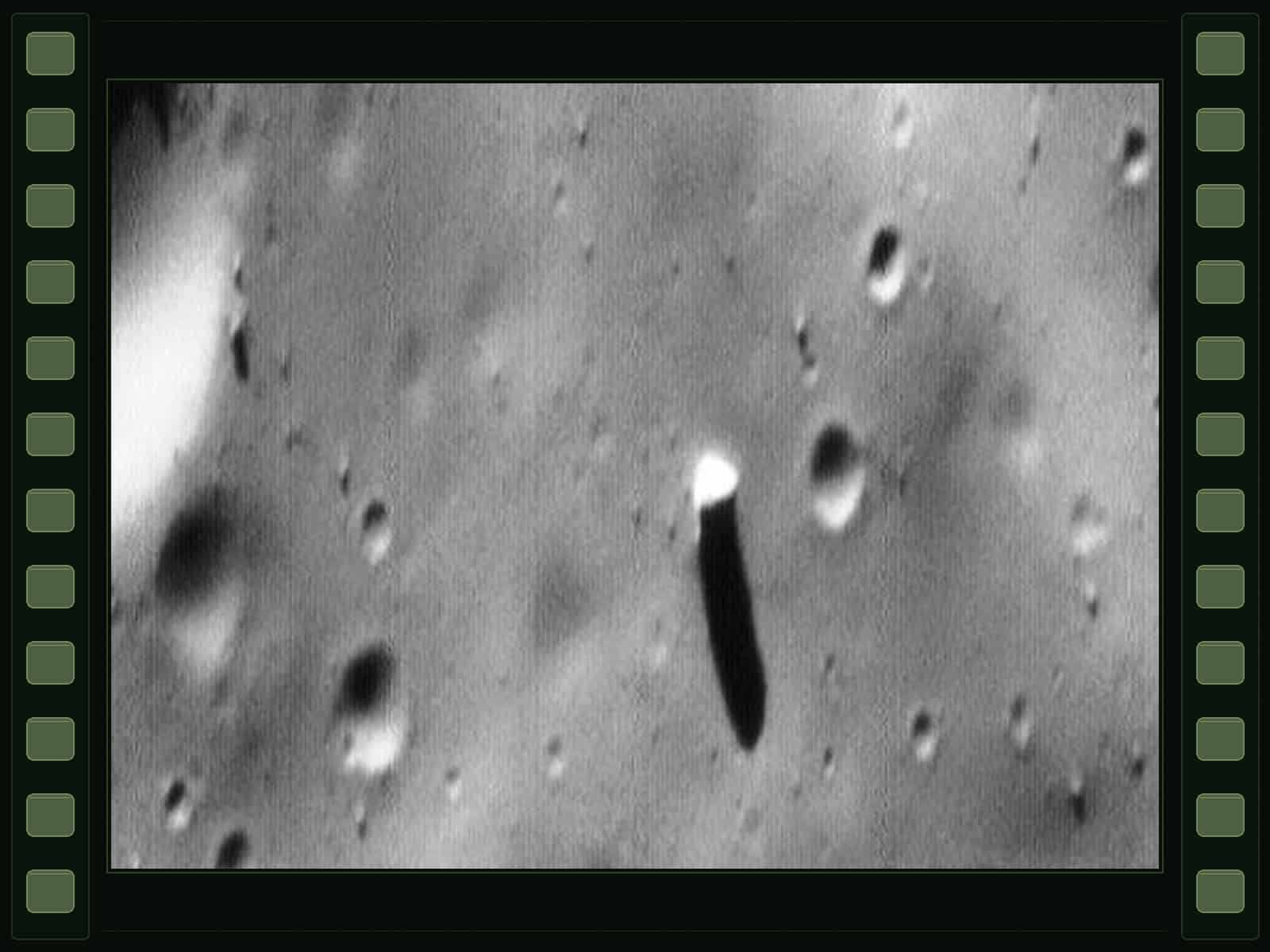
Phobos is already a strange little moon, a battered potato hanging over Mars. Then you get this: an isolated bright object standing away from the jumble, casting an enormous dark shadow across the surface, like a pillar somebody erected and walked away from.
The standard reading is a large boulder, maybe thrown there by an impact. Ejecta. A rock that landed on end and has been throwing that shadow ever since.
That’s tidy. The picture is not tidy. The shadow is huge. The object looks deliberate. People who already wonder whether Phobos is more than a dead moon see a standing stone in this frame, and I understand why. Even if it is only a boulder, it’s a boulder that behaves on camera like a monument.
Sources: Wikimedia Commons file, from Mars Global Surveyor MOC 55103.
10. The Mars Doorway
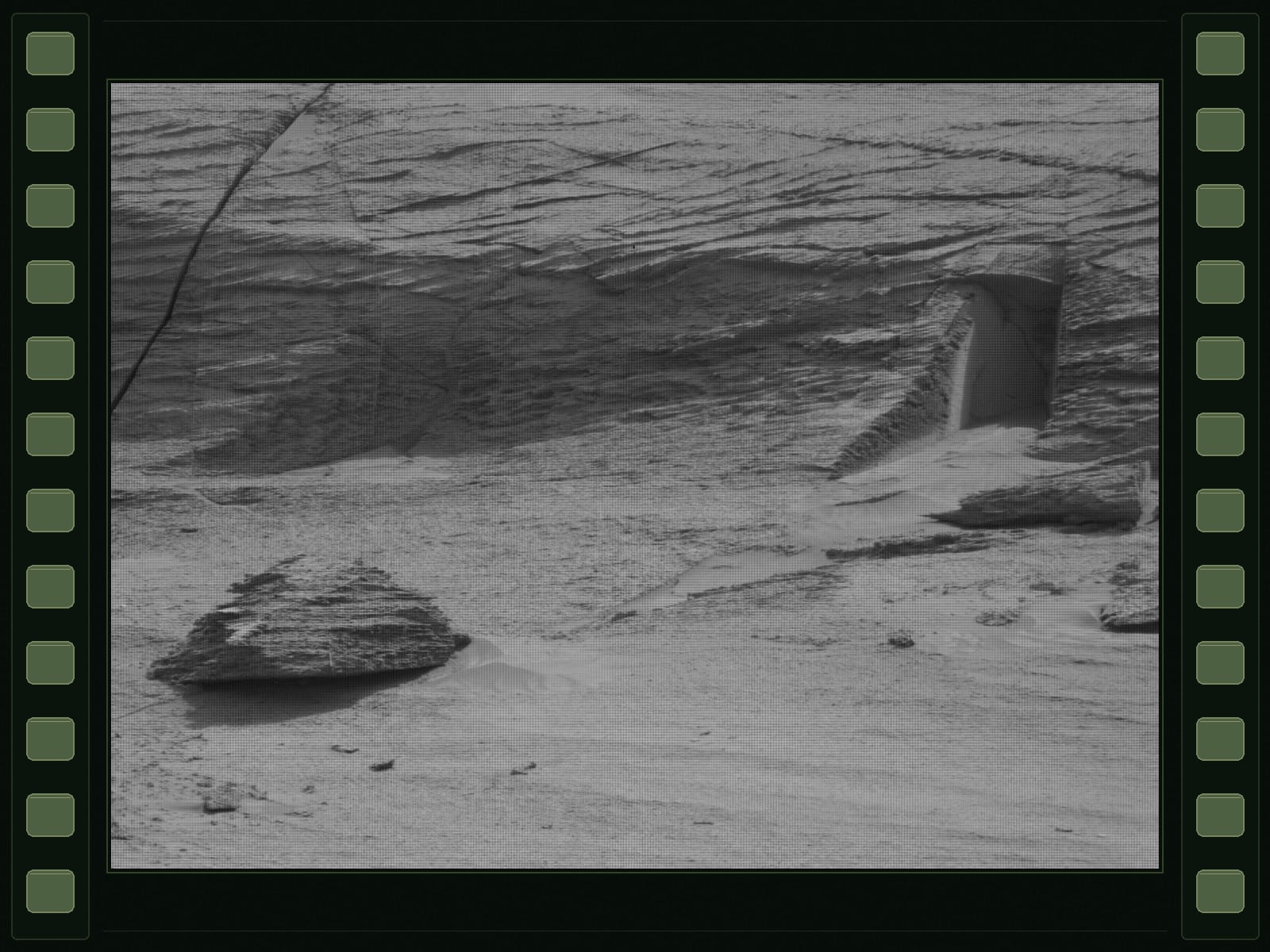
When this Curiosity frame hit the internet, people did not need help seeing it. There’s a rectangular opening in the layered rock that looks almost exactly like a door cut into a cliff. Not a crack that sort of reminds you of a door. A doorway. Dark inside, squared off, waiting.
NASA says higher-context imagery shows a small, naturally occurring fracture. Wind, time, the way Martian rock breaks. Not an entrance to anything.
I’ll give them that sentence. Then I’m going back to the picture, because once you’ve seen a door, it’s hard to unsee a door. The rover was sitting there photographing geology, and the geology arranged itself into an entrance. If this were a still from a movie, you’d know what happens next: somebody walks through.
Sources: NASA Curiosity raw image page.
11. De Loys’s Ape
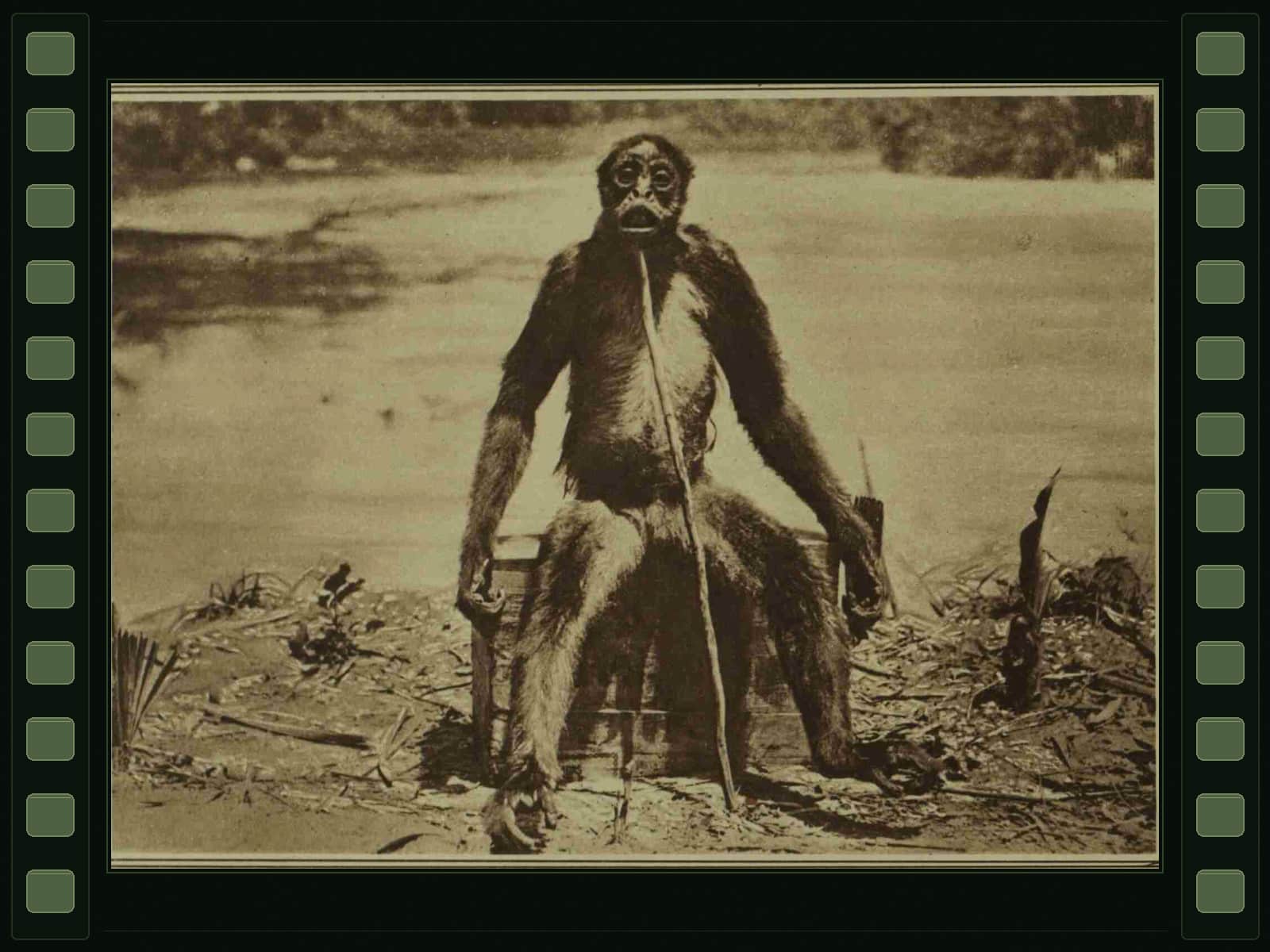
This photograph shows an animal sitting upright on a crate in a jungle clearing, looking much too big and much too human for comfort. François de Loys brought it back from a South American expedition. In 1929 the Illustrated London News published it, and it was promoted as an unknown ape, a kind of missing American cousin.
I want to be clear about what you’re looking at. The creature is dead. It has been propped up. There are no human remains in the picture. The shock comes from the pose and the face, not from anything gruesome beyond that.
The mainstream reading now is that this is a spider monkey presented in a misleading way, or part of a hoax. Take away a tail, sit the body on a box, and a familiar animal can look like a monster. That’s the probable explanation.
Even knowing that, the photograph still works on you. It looks like something that shouldn’t be sitting on a crate in that clearing. De Loys is gone. The jungle doesn’t care. We’re left with one strange picture that launched a creature into the lore, and a question about how much of what we’re seeing is the animal and how much is the way it was shown to us.
Sources: Wikimedia Commons file from the June 15, 1929 Illustrated London News.
12. D.B. Cooper’s Recovered Ransom Money
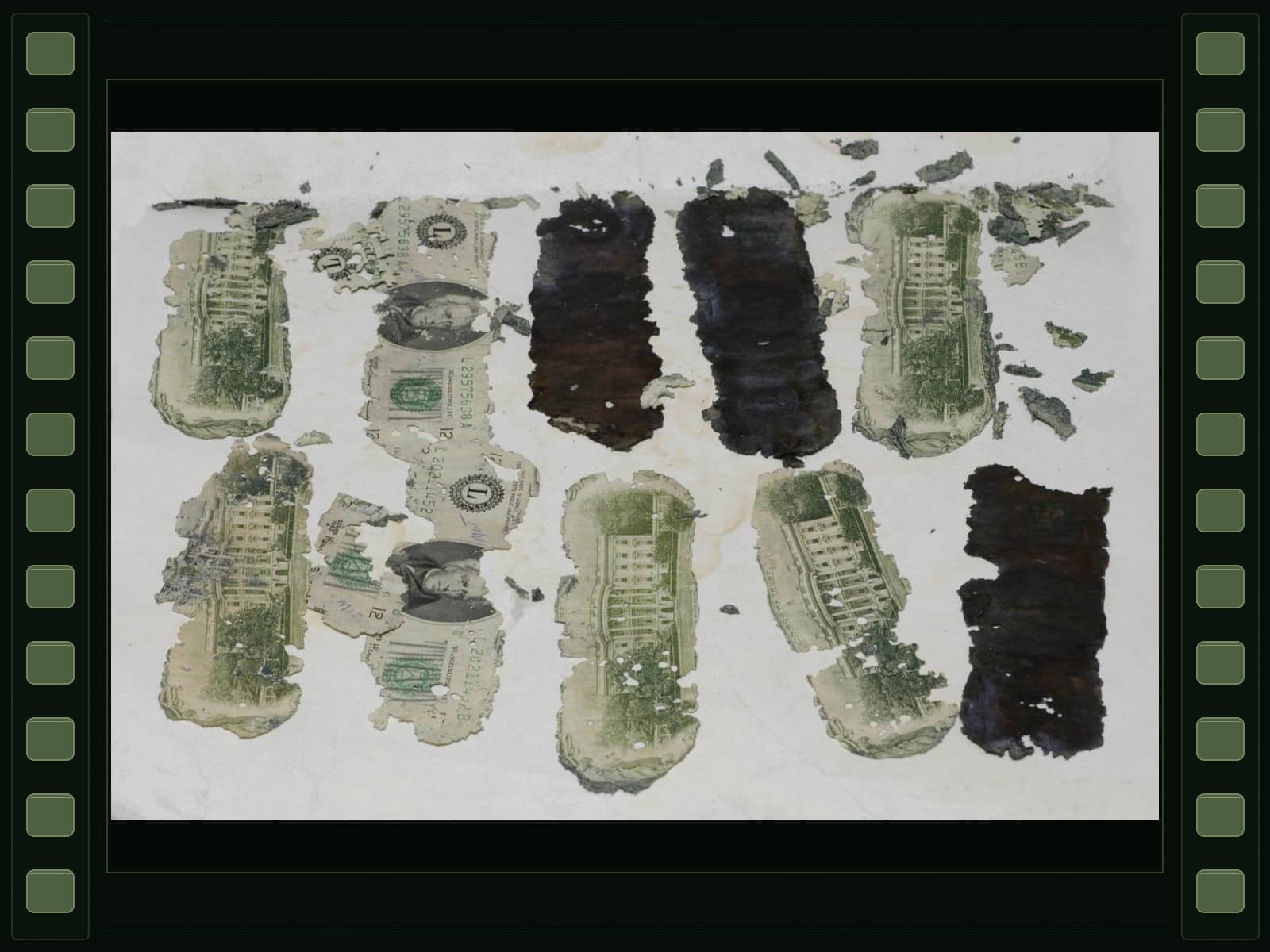
This one isn’t a ghost, and it isn’t a light in the sky. It’s a pile of ruined twenties, and it might be the strangest genuine clue in the whole set.
In 1971, a man who called himself Dan Cooper hijacked a plane, collected a ransom in twenty-dollar bills, and jumped into the night over the Pacific Northwest. He was never found. Nine years later, in 1980, decaying bundles of those bills turned up along the Columbia River. The FBI matched the serial numbers. This is that money.
A boy named Brian Ingram found about $5,800 of it on a riverbank known as Tina Bar. That’s the physical leftover of an unsolved hijacking: not a rumor, not a lookalike, the actual ransom, rotting in the sand.
What nobody has ever really explained is how it got there. Did Cooper land nearby? Did the money fall from his body in the jump and drift? Did someone else move it? The Bureau could tell you these bills were his. They could not tell you the path they took to that riverbank. For a case this famous, that’s a pretty loud silence.
Sources: Wikimedia Commons file of the FBI evidence photograph.
13. The St. Augustine Monster
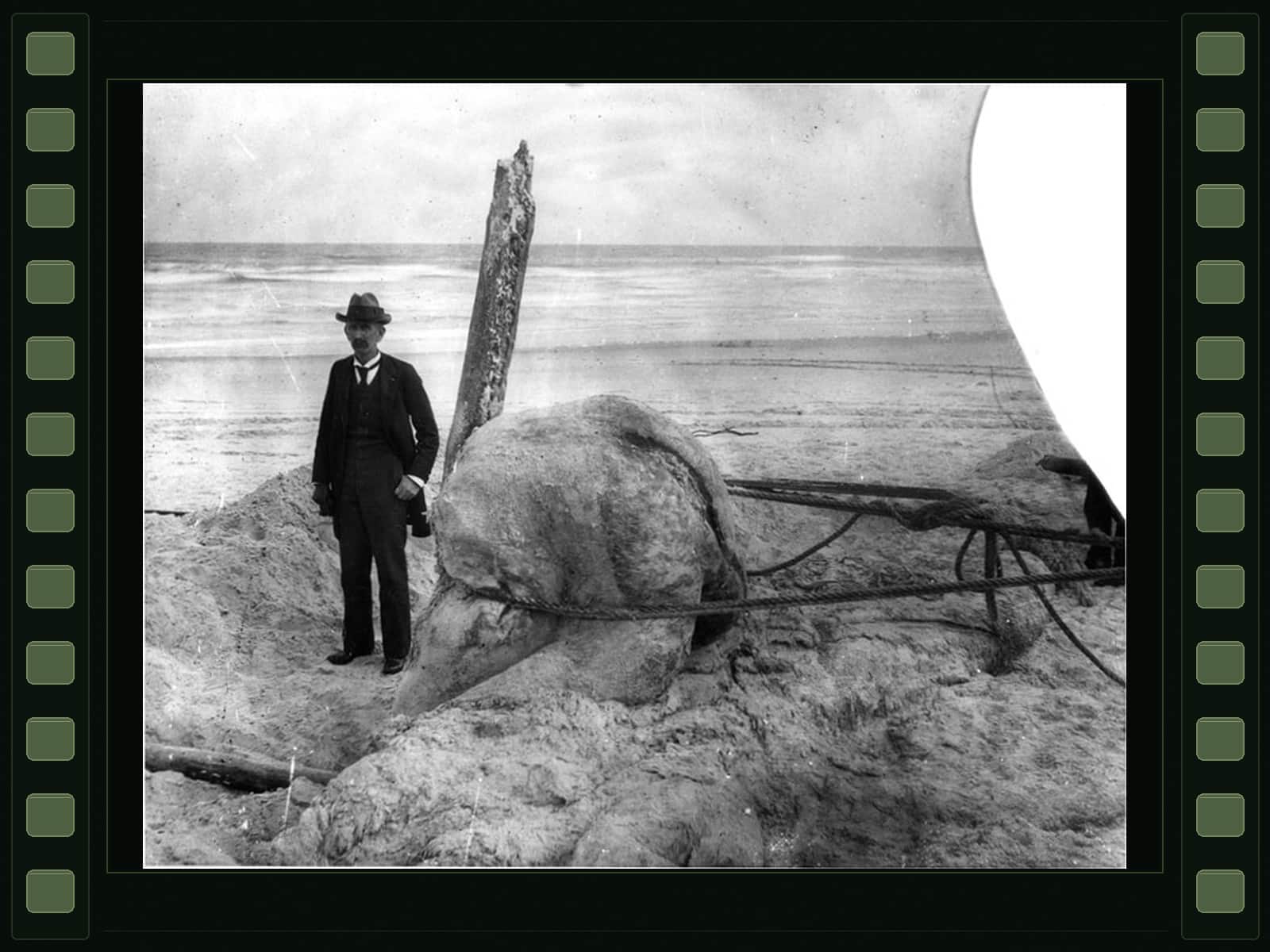
A man stands on a Florida beach next to a pale mass so large it makes him look small. This is the St. Augustine Monster, photographed in January 1897. What washed ashore near St. Augustine was first taken for a gigantic octopus, something that didn’t belong in any ordinary fisherman’s world.
Later researchers argued that the mass was decomposed animal tissue, most often described as whale remains rather than an unknown monster. That’s the modern scientific reading, and it may well describe what the flesh turned out to be.
I’m still left with the photograph. Whatever it was, it was real, and it was enormous, and somebody thought it mattered enough to stand beside it for the camera. A lot of sea mysteries shrink once a lab gets a sample. This one became a whale in the paperwork and somehow stayed a monster in the picture. Look at the scale of that thing next to the man. I don’t need it to be a new species to feel the beach go quiet around it.
Sources: Wikimedia Commons file.
After the last frame
Thirteen photographs. A chair that should have been empty. A woman in white a scientist was willing to stand beside. Lights over a wartime city and lights over a Coast Guard station. Faces and doorways and standing stones on other worlds. A crate in the jungle. A riverbank of ruined cash. A carcass the size of a legend.
Some of these have official explanations. I told you those. I also think the camera, more than once, caught something that still doesn’t sit right after you’ve heard them. If one of these frames has been living in your head, I’d love to know which one.




0 Comments