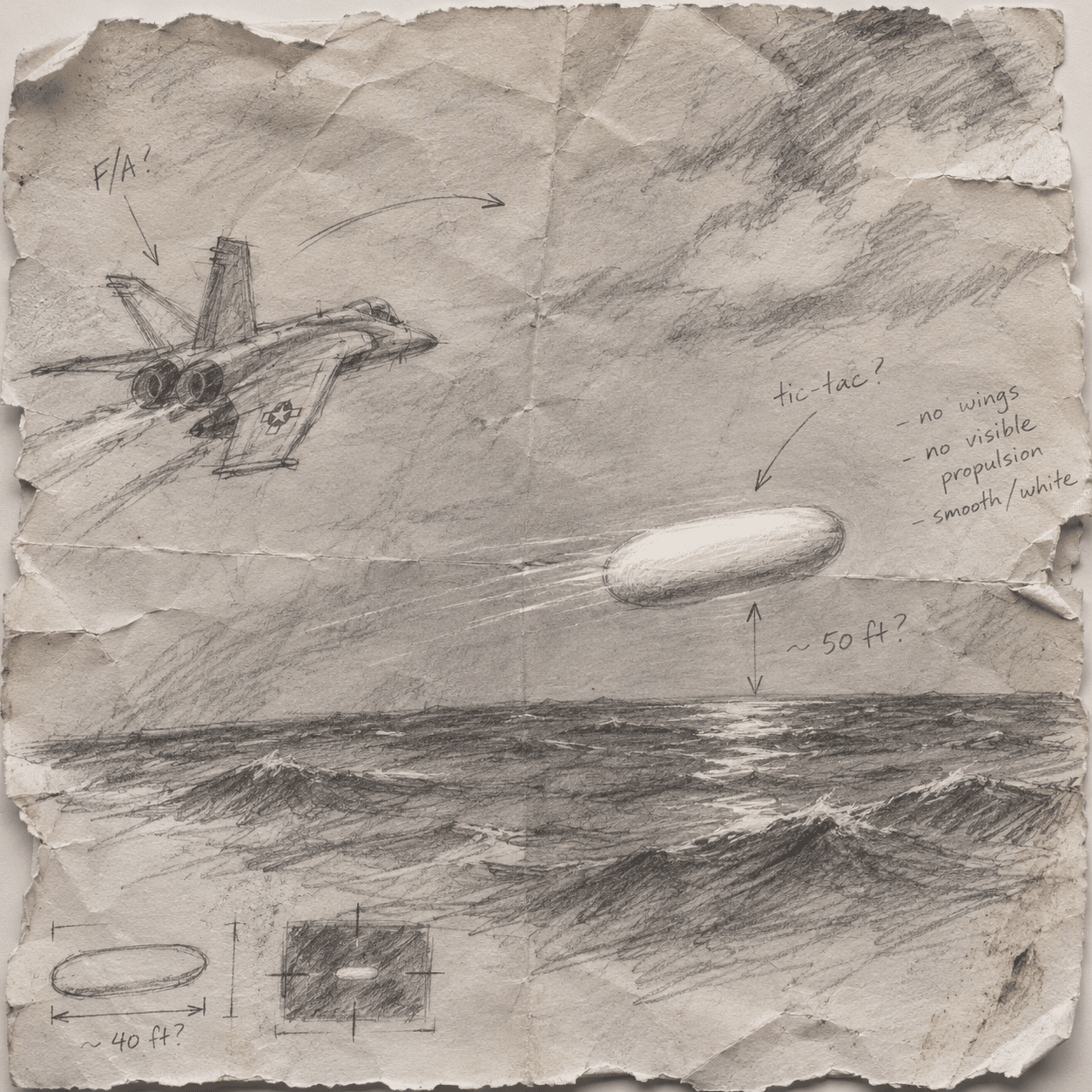
On November 14, 2004, two Navy fighter jets were diverted from a training exercise off Southern California. Below them, a patch of ocean churned white against otherwise calm water. Above that disturbance, Commander David Fravor says he saw a white object shaped like a Tic Tac, moving abruptly without visible wings or rotors.
Fravor descended. The object climbed toward him. As he maneuvered closer, he says, it accelerated and disappeared.
That encounter is why I keep returning to military UFO encounters. Strip away the dramatic music and there is still a difficult story: four aviators, a cruiser directing an intercept, and a later infrared recording. But those pieces are not interchangeable. The famous video does not show Fravor’s close encounter. His description of extraordinary acceleration is testimony, not a speed measurement anyone can read off the released footage.
The distinction matters. Some military sightings have substantial paper trails. Others lean on memories recorded decades afterward. An official document can prove that a report reached military intelligence without proving that its subject was an alien vehicle.
So let’s follow the encounters themselves, from the lights that followed World War II aircrews to the Navy footage that dragged UFOs back into Congress. The record is strange enough without giving it abilities it hasn’t earned. 1
Foo Fighters: Lights Beside the Night Fighters
Before flying saucers became a household phrase, Allied airmen were already reporting things they couldn’t identify.
In late 1944, crews of the U.S. Army Air Forces’ 415th Night Fighter Squadron described luminous objects over the Rhine region. Smithsonian’s aviation history recounts a November flight involving pilot Edward Schlueter, radar observer Donald Meiers, and intelligence officer Fred Ringwald. They reported orange lights off their wing; neither airborne radar nor ground control registered a corresponding contact. The lights disappeared when the aircraft turned toward them, then appeared farther away.
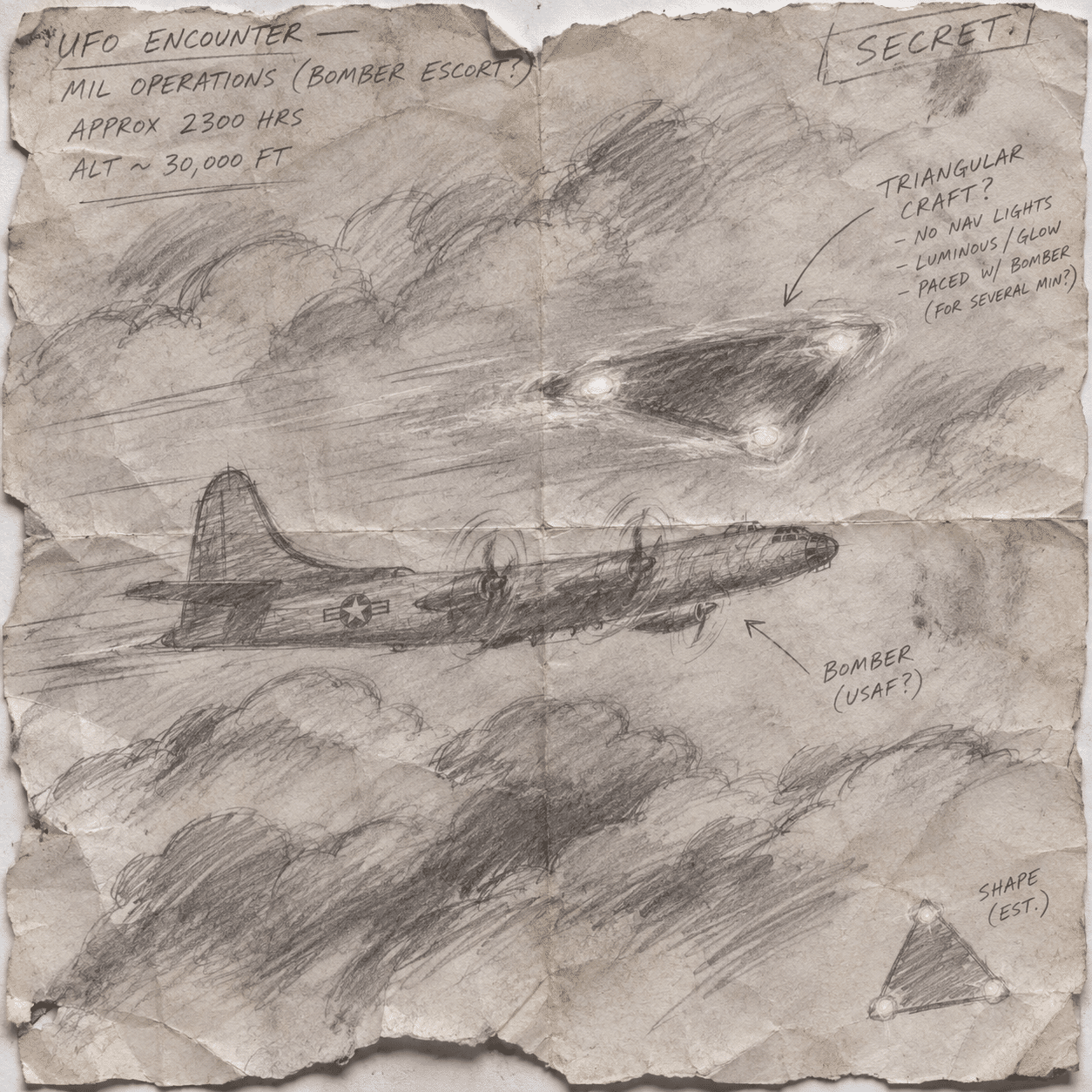
Other reports described red, orange, or green lights pacing aircraft. The squadron’s nickname for them, borrowed from the Smokey Stover comic strip, was “foo fighters.” An Associated Press correspondent helped carry the stories into newspapers at the beginning of 1945. 2
I find the wartime setting unnerving for a practical reason. A light following your aircraft above enemy territory could mean a weapon. The crews did not have the luxury of treating it as entertainment.
Possible explanations include electrical discharges, atmospheric effects, celestial misidentifications, and perceptual problems during night flying. St. Elmo’s fire is often suggested, although witnesses describing detached, maneuvering lights did not think it fitted their experience. A German secret weapon was another contemporary suspicion; no demonstrated weapon has emerged that explains the whole collection.
There is no single instrument record that resolves “the foo fighters.” That label bundles different observations. The reports deserve historical attention, but treating every light as the same machine would manufacture a consistency the evidence does not provide.
Washington, 1952: Radar Returns Over the Capital
During the nights of July 19–20 and July 26–27, 1952, radar operators around Washington, D.C., reported unusual returns. Visual reports followed, and Air Force interceptors were dispatched. Suddenly the flying-saucer argument concerned the airspace around the nation’s capital. 3
The enduring image is of jets chasing something that vanished when they approached. The documentary picture is less tidy: different radar installations, intermittent contacts, visual lights whose relationship to individual radar targets was uncertain, and an investigation conducted under enormous public pressure.
The Air Force explanation emphasized temperature inversions and anomalous radar propagation, alongside misidentified lights. Under certain atmospheric conditions, radar energy can bend in unexpected ways and generate misleading returns. A contemporary Civil Aeronautics Administration technical study examined unidentified targets on air-traffic-control radar and the role of atmospheric conditions. That is a real mechanism, not merely a weather word attached to an embarrassing headline. 4
Whether it explains every reported observation is a separate question. Witnesses disputed aspects of the explanation, and the available accounts do not let us confidently pair every light, radar blip, and scramble. What we can establish is that the alerts happened; the existence of interceptors does not establish an extraordinary aircraft.
This was the world of Project Blue Book. The National Archives preserves an Air Force summary recording 12,618 reports from 1947 through 1969, with 701 remaining unidentified. Those totals span the Air Force’s UFO investigations, not just Blue Book’s years under that name. The service concluded that its investigations had produced no evidence of extraterrestrial vehicles or technology beyond contemporary scientific knowledge. 5
An unidentified case was an unfinished identification, not an official vote for visitors. That distinction has been getting lost since the early days.
The RB-47 Encounter: When Several Instruments Seem to Agree
The 1957 RB-47 case is more complicated than an odd light outside a cockpit. A six-man Air Force reconnaissance crew, including pilot Lewis Chase and electronic-warfare officer Frank McClure, reported visual observations and electronic signals during a training flight over the south-central United States.
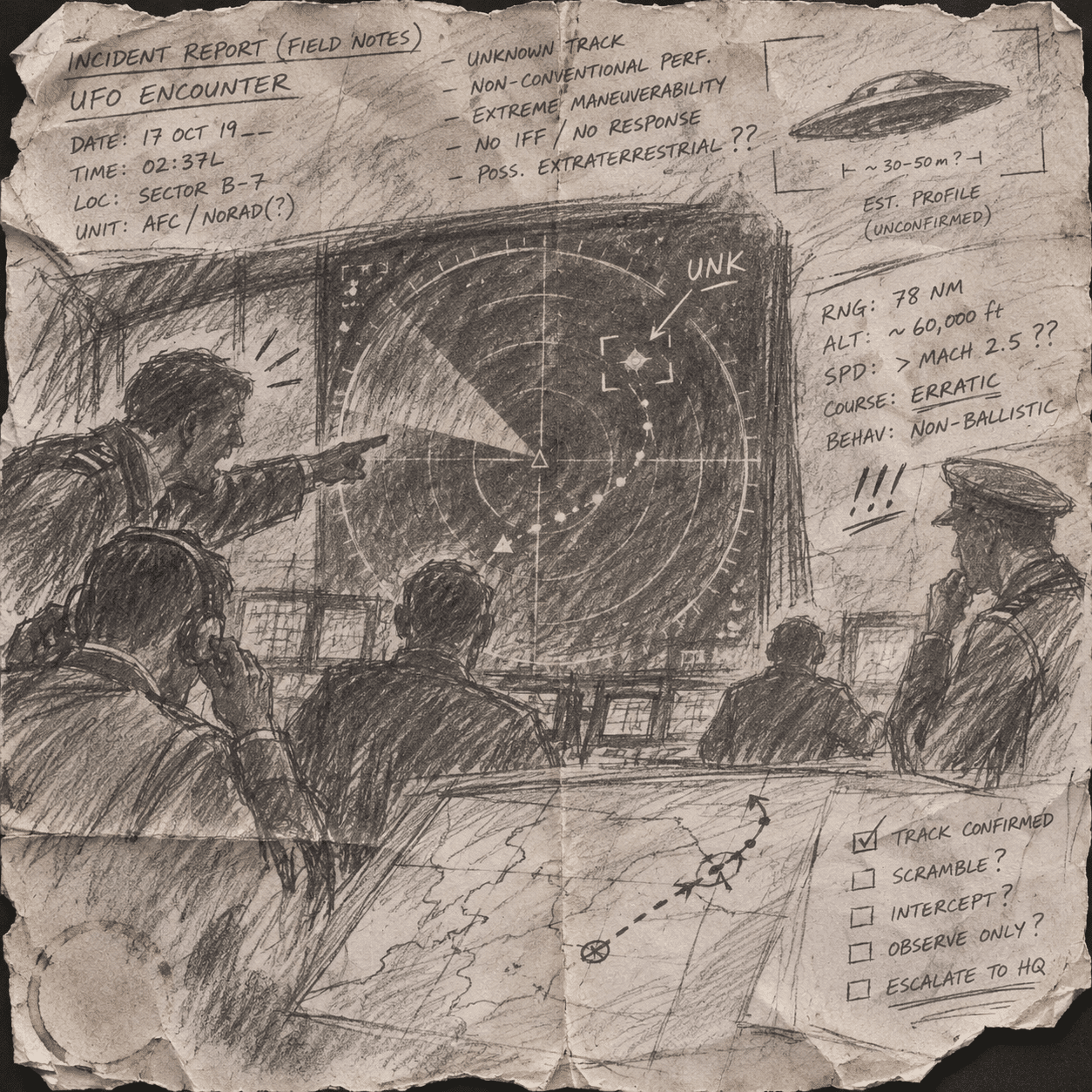
The encounter is generally dated July 17, 1957. The later Colorado study—the Condon Report—called it a fall 1957 event, illustrating how even the basic chronology became tangled before researchers found additional paperwork. 6
In the crew’s account, a bright light crossed ahead of the aircraft. An electronic-monitoring receiver detected a signal that seemed to change bearing in concert with the sighting. Ground radar reportedly tracked a target as well. The apparent correspondence is what makes this case interesting: several ways of observing something, apparently pointing toward the same event.
Yet the original Condon investigation was working with recollections about ten years old. Its case study explicitly records disagreements over whether film and wire recordings had ever been made. The pilot remembered intelligence personnel taking recorded material; other crew members said the necessary recording supplies had not been aboard. The study could not recover the instrument evidence. 7
Skeptical explanations have combined ordinary aircraft or a meteor for visual portions with ground-radar signals and electronic-reception effects. The Blue Book paperwork includes an aircraft identification whose connection to the reported event has been challenged. Physicist James McDonald and skeptic Philip Klass reached opposing interpretations; neither supplied the missing continuous record.
The Condon case remained unidentified because the surviving descriptions were inadequate to identify it. That is an intriguing outcome, especially inside a study remembered for its skeptical overall conclusions. It is still weaker than the popular version in which preserved, synchronized instruments conclusively tracked an impossible craft.
Malmstrom: What Actually Happened to the Missiles?
Few UFO stories are more disturbing than the suggestion that something could switch off nuclear missiles.
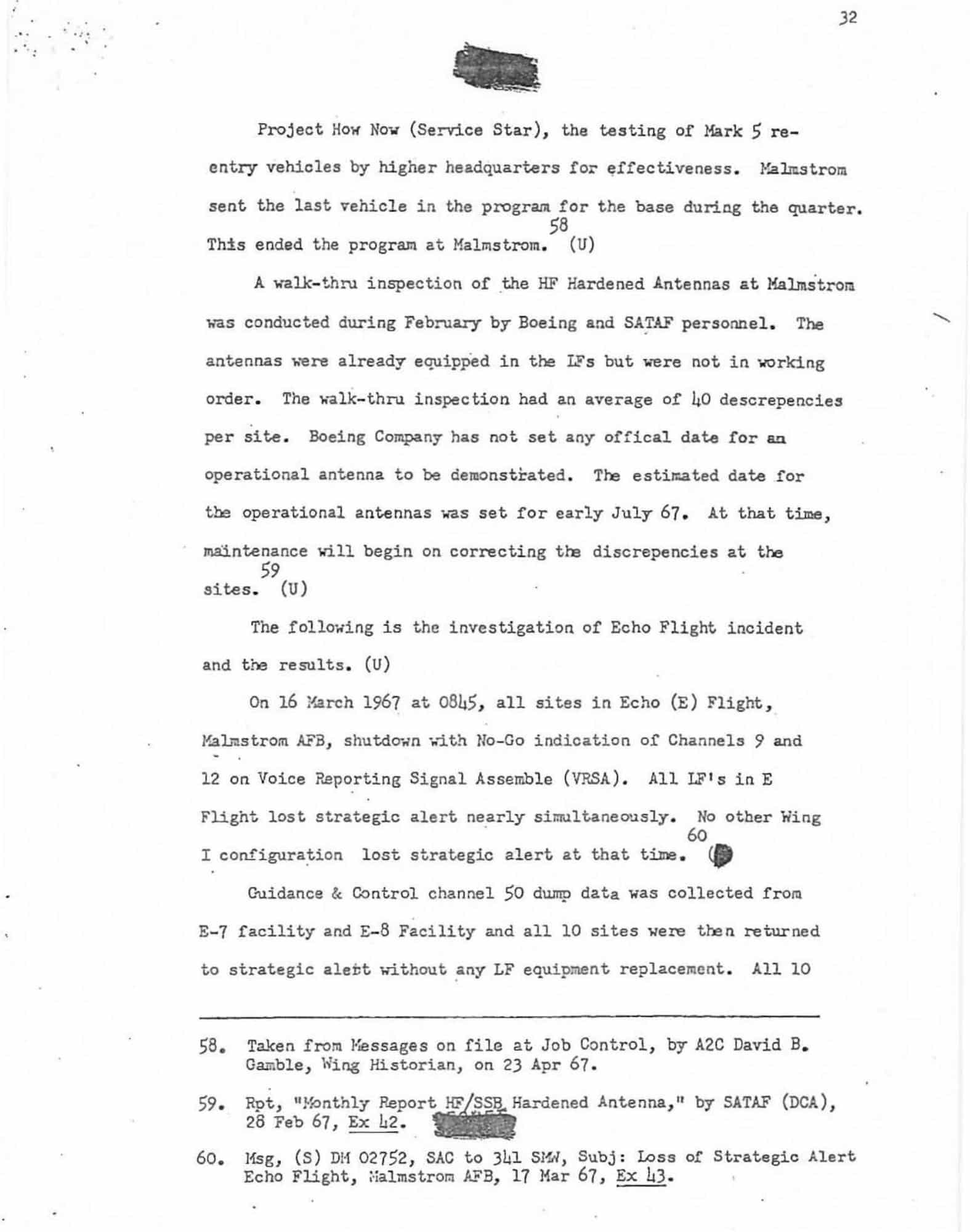
A real incident anchors the Malmstrom story. On March 16, 1967, all ten Minuteman missiles in Echo Flight at Malmstrom Air Force Base, Montana, lost strategic-alert status nearly simultaneously. The 341st Strategic Missile Wing histories document the shutdown and the engineering investigation. The missiles were not launched or physically destroyed; their readiness was interrupted.
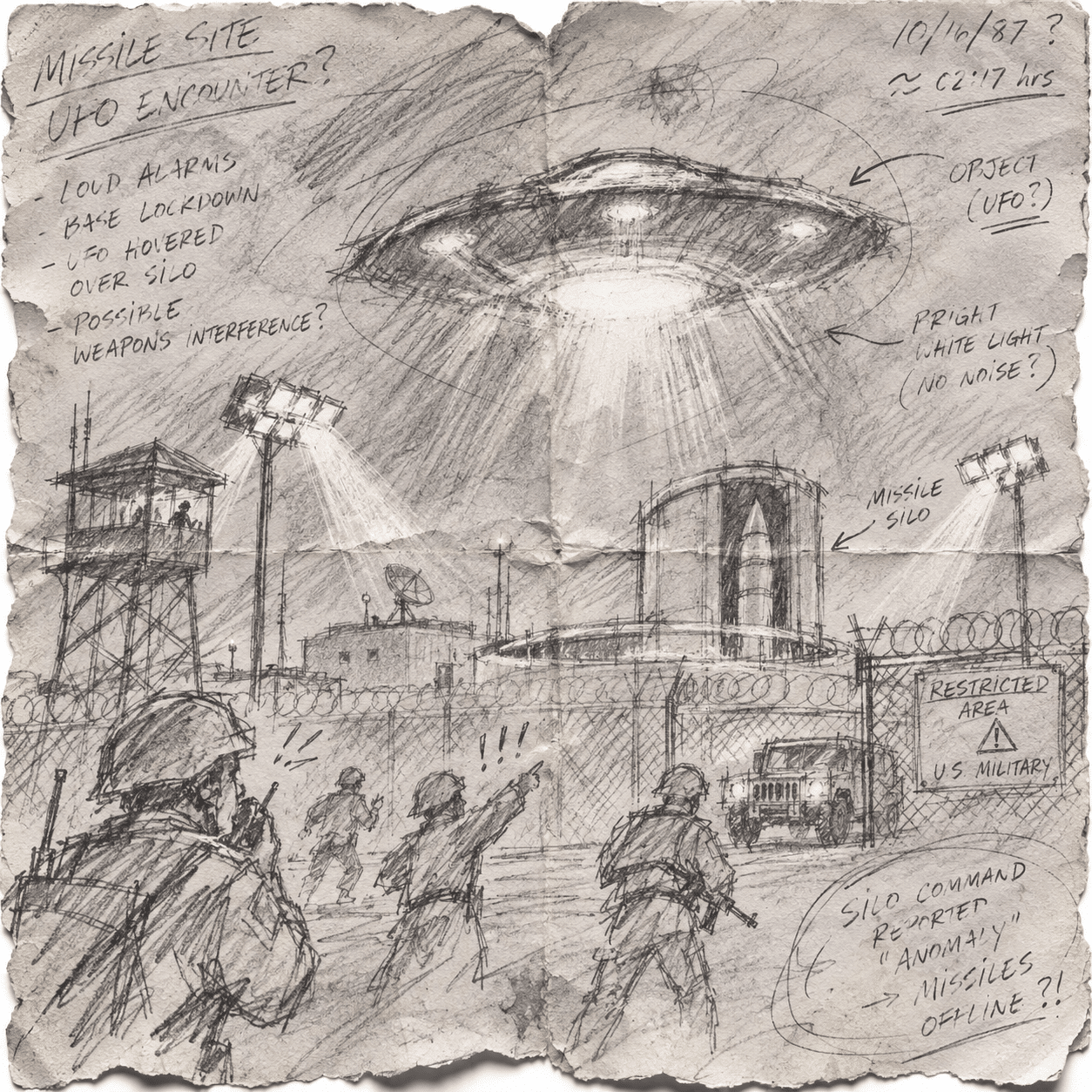
Later UFO accounts link the failure to unusual objects reported around missile installations. Former launch officer Robert Salas described receiving urgent telephone reports from topside security while he was underground, followed by missiles going off alert. His initial published reconstruction connected his memory with Echo, then reconsidered the flight assignment. Later versions place his own experience at Oscar Flight. He was not claiming to have watched a craft from inside the underground capsule. 9
That separation is essential. The documented Echo outage and Salas’s account are regularly spliced into one perfectly corroborated event. They are not the same evidentiary item.
The contemporary wing history states that rumors of UFOs around Echo during the fault “were disproven.” It also records the investigation’s initial inability to identify a logical cause. Later engineering work investigated noise pulses entering logic-coupler circuitry and reproduced relevant failure responses in testing. These records support an electrical susceptibility; they do not identify a UFO as the source. 8
Salas challenges the official dismissal and maintains that the reports were genuine. The public material does not settle every disagreement about witnesses, dates, or a separate shutdown. It does establish why “aliens disabled ten nuclear missiles” goes further than the documentation permits.
For me, the unresolved engineering history is worth reading on its own. A frightening coincidence is a reason to investigate causation, not a substitute for proving it.
Tehran, 1976: An Intercept and Reported Equipment Failures
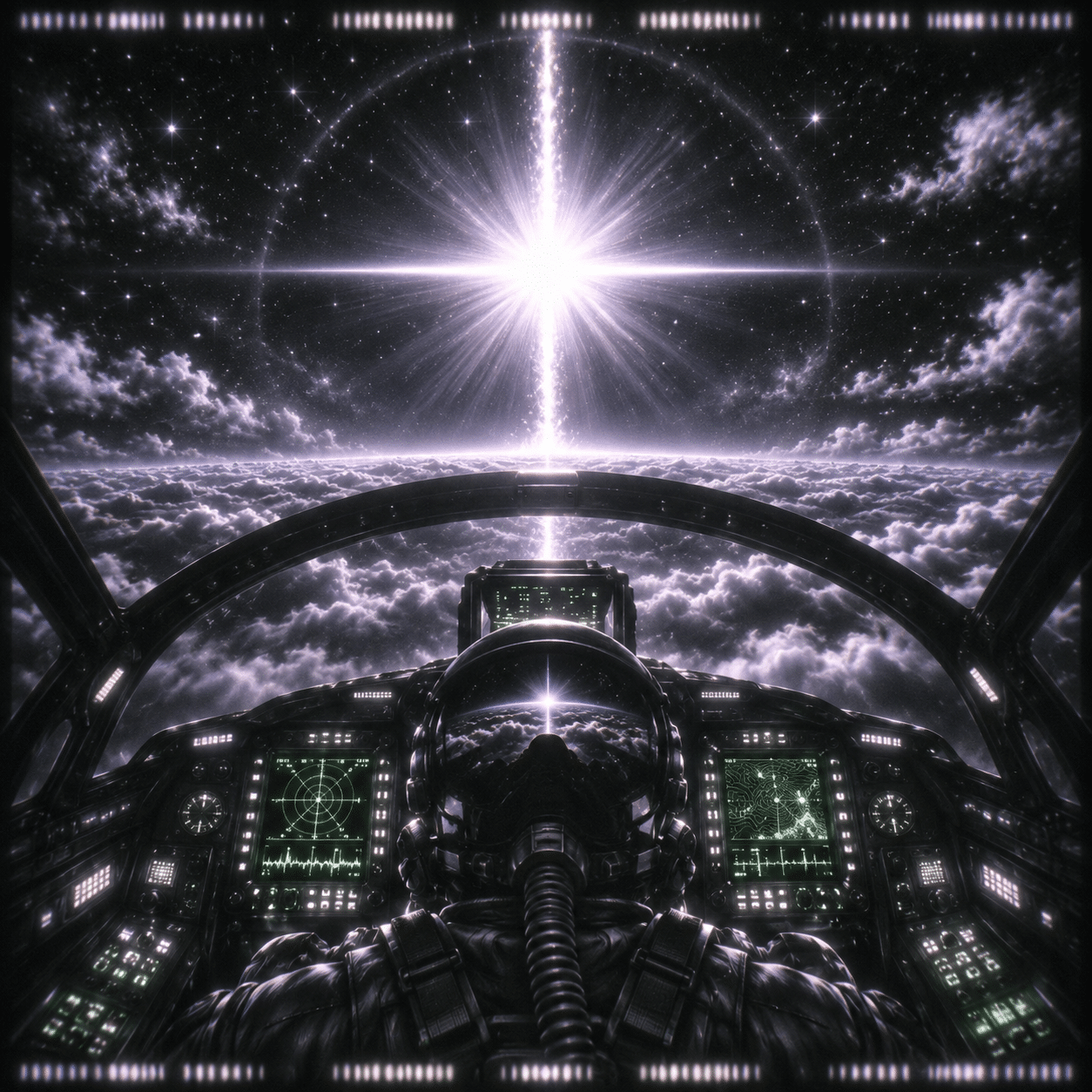
On September 19, 1976, the Imperial Iranian Air Force scrambled F-4 fighters after reports of a brilliant object over Tehran. A U.S. defense-attaché report describes the first aircraft losing instruments and communications during its approach, then recovering them after turning away.
A second F-4 reportedly obtained a radar lock. Its pilot, Parviz Jafari, later became the best-known public witness. According to the contemporary report, a smaller bright object appeared to approach the fighter. When the pilot attempted to fire an AIM-9 missile, the weapons-control panel and communications reportedly failed. The report says those functions subsequently returned. 10
This is unusually strong documentary evidence that a dramatic military UFO report circulated through U.S. intelligence channels. An accompanying Defense Intelligence Agency evaluation rated it highly, citing multiple witnesses, radar, and reported electromagnetic effects.
Read that praise carefully. The evaluation assessed the report’s intelligence value; it was not a laboratory confirmation of a machine capable of remotely disabling fighters. The attaché message itself explains that the information passed through a source speaking with a pilot. That reporting chain leaves room for omissions and misunderstandings. 10
Philip Klass proposed a combination of a bright celestial object, meteors, equipment problems, and misinterpreted radar information. Later critics and proponents disagree about the aircraft’s condition and whether those explanations fit the sequence. A bright planet might explain a conspicuous light without explaining every claimed failure; a reported failure does not by itself prove external interference. 11
What keeps Tehran alive is the combination. What prevents a verdict is the absence of a publicly available, complete technical reconstruction tying maintenance records, radar data, communications, and independent observations together. The cable is real. The extraordinary causal story remains disputed.
Rendlesham Forest: The Memo and the Growing Legend
In late December 1980, U.S. Air Force personnel stationed at RAF Woodbridge and RAF Bentwaters reported strange lights near Rendlesham Forest in Suffolk, England.
The central document is Lieutenant Colonel Charles Halt’s January 13, 1981, memorandum, titled “Unexplained Lights.” It describes patrolmen investigating a glowing object in the forest, ground depressions found afterward, radiation checks, and later lights witnessed by Halt and others. Halt also made an audio recording during the later excursion. 12
The memo does not give us a single uninterrupted encounter. Part of it relays what other servicemen said; part describes Halt’s own observations. Its dates also require care: researcher Ian Ridpath notes that the first and later nights are generally reconstructed as December 26 and 28, rather than the dates Halt wrote from memory. 13
Ridpath’s skeptical investigation proposes several ordinary causes rather than one: the Orford Ness lighthouse for a flashing light through the trees, bright stars for lights higher in the sky, and commonplace ground marks. He also questions whether the radiation readings demonstrated an unusual exposure. Those arguments address physical details that later retellings often glide past. 14
Witnesses have rejected the lighthouse explanation, and later accounts add close-range details absent from the original memo. That does not automatically make those recollections false. It does mean we should avoid projecting everything said years afterward backward into the earliest record.
Britain’s National Archives says the Ministry of Defence found no defence significance and holds a single-sheet report of the event itself, alongside later correspondence. A limited official investigation cannot prove that nothing unusual occurred. It cannot be presented as a hidden, comprehensive confirmation either. 12
Rendlesham’s atmosphere is irresistible: military patrols, dark woodland, a deputy base commander recording what he sees. I would rather preserve that unsettling core than bury it beneath additions the contemporary paperwork cannot support.
Belgium: Triangles, F-16s, and Uncertain Radar Locks
Beginning in late 1989, witnesses in Belgium reported large objects with lights often described in a triangular arrangement. Police officers were among the witnesses. On the night of March 30–31, 1990, two Belgian F-16s were sent to investigate reported radar contacts.
The fighters obtained intermittent radar locks, with apparent changes in speed and altitude that helped turn the interception into UFO legend. The pilots did not visually confirm a corresponding extraordinary craft. A radar lock and a close-range sighting are different things. 15
Physicist Auguste Meessen, a prominent investigator sympathetic to the Belgian reports, later analyzed the F-16 data in detail. His discussion considers atmospheric returns, radar processing, and contacts involving the fighters themselves. He continued to regard other elements of the wave as unexplained, but his analysis shows why the interceptor displays cannot simply be read as a flight recorder for a physics-defying triangle. 15
Ordinary aircraft, stars, and expectation may explain portions of the wider wave. That does not identify every witness’s observation. Equally, a collection of unresolved sightings does not validate each disputed radar reading.
There is another trap: the famous Petit-Rechain triangle photograph. Its maker publicly said in 2011 that it was a model hoax. Whatever anyone thinks of the broader Belgian events, that picture should not be offered as a photograph of the object the F-16s chased. It was not an image taken during that interception. 16
This case leaves a useful, uncomfortable lesson. A wave can include sincere witnesses, uncertain instrument returns, and a fabricated photograph at the same time. We do not have to accept or reject the whole bundle.
Nimitz, 2004: The Tic Tac and the Separate FLIR Recording
Back to that white object above the Pacific.
Fravor’s July 26, 2023, congressional statement provides a clear first-person account. He says the cruiser USS Princeton redirected his flight to investigate a contact. He and the other aviators saw disturbed water and a white Tic Tac-shaped object. His fellow pilot, Alex Dietrich, remained higher while he descended. Fravor described the object climbing toward him, then accelerating out of sight. 1
He also recounted being told that a contact appeared at their combat-air-patrol point roughly sixty miles away shortly afterward. That part comes through the controller and radar account; Fravor did not personally watch an object cover those sixty miles. Claims about earlier enormous altitude changes likewise depend on what shipboard personnel reported, not what his cockpit instruments independently measured.
Later, another crew, including Lieutenant Chad Underwood, recorded the infrared footage commonly called FLIR1. Underwood’s recording is associated with the same day’s events, but it does not film the original visual intercept. The public cannot demonstrate continuous identity between every reported radar contact, Fravor’s object, and the later infrared target using the released clip alone. 117
The video shows an infrared target being tracked, then moving out of the tracking area. Analysts including Mick West argue that camera tracking and viewing geometry can explain apparent motion in the clip without exceptional acceleration. That challenges what can be inferred from the footage; it does not by itself reconstruct what Fravor and Dietrich saw earlier. 18
As checked for this article, AARO lists FLIR as an unresolved case. The strongest public version of Nimitz is therefore a combination of named eyewitness testimony and authentic but limited Navy imagery—not a publicly reproduced demonstration of impossible speed. 17
That is still worth serious attention. An experienced combat aviator can make an honest observational error, but his account should be examined rather than dismissed because the subject has become embarrassing.
Roosevelt, Gimbal, and GoFast: Three Different Kinds of Evidence
Former Navy pilot Ryan Graves described repeated encounters during 2014–2015 training associated with the USS Theodore Roosevelt air wing. In his congressional statement, he said upgraded radar initially detected unknown objects that crews suspected were glitches; infrared observations then persuaded them something physical was present. 19
He also recounted a colleague’s near encounter with a dark cube inside a clear sphere at a training-area entry point. Graves was relaying another pilot’s visual description, not claiming he personally looked through his canopy and saw that shape. His own sensor experience and his colleagues’ close-range accounts should remain separately attributed.
Balloon-borne radar reflectors have been proposed for cube-and-sphere descriptions. 26 Radar artifacts, ordinary airborne objects, and electronic deception are other possibilities investigators must test. None becomes a case-specific identification without the right telemetry, wind information, and a reliable match to the sighting.
The Gimbal and GoFast videos belong to the broader East Coast story, but they do not show every episode Graves described. Gimbal presents a dark infrared shape that appears to rotate. West and other skeptical analysts argue that infrared glare and the targeting system’s rotation can produce that appearance. In that interpretation, the rotating outline need not be the outline of a rotating vehicle. AARO currently lists Gimbal as unresolved. 1718
GoFast is the clearest warning against trusting appearances. The object seems to race just above the ocean. AARO’s February 2025 analysis instead places it at approximately 13,000 feet and attributes the striking apparent speed to motion parallax—the effect of observing it from a fast-moving aircraft. The office assessed with high confidence that it showed no anomalous performance, while saying it could not definitively identify the object. 20
Unidentified, then, does not necessarily mean inexplicable motion. A mundane object can remain unnamed after its supposed superpower disappears.
That finding does not solve every Roosevelt-era report. It changes what one specific video supports. The distinction protects good reporting from collapsing when a famous clip receives an ordinary explanation.
How Military UFO Encounters Reached Congress
The December 2017 New York Times reporting on the Pentagon’s UFO effort, widely associated with the name AATIP, changed the public conversation. Navy footage and named witnesses reached readers who would never have opened an old Blue Book file. Subsequent reporting and official reviews have complicated the history of AATIP and the related AAWSAP contract; the program names should not be treated as proof that the Pentagon verified alien vehicles. 21
On April 27, 2020, the Department of Defense officially released the three Navy videos: one recorded in November 2004 and two in January 2015. The announcement authenticated their Navy provenance and described the phenomena as unidentified. It did not certify extraterrestrial origin or endorse every performance claim made about them. 22
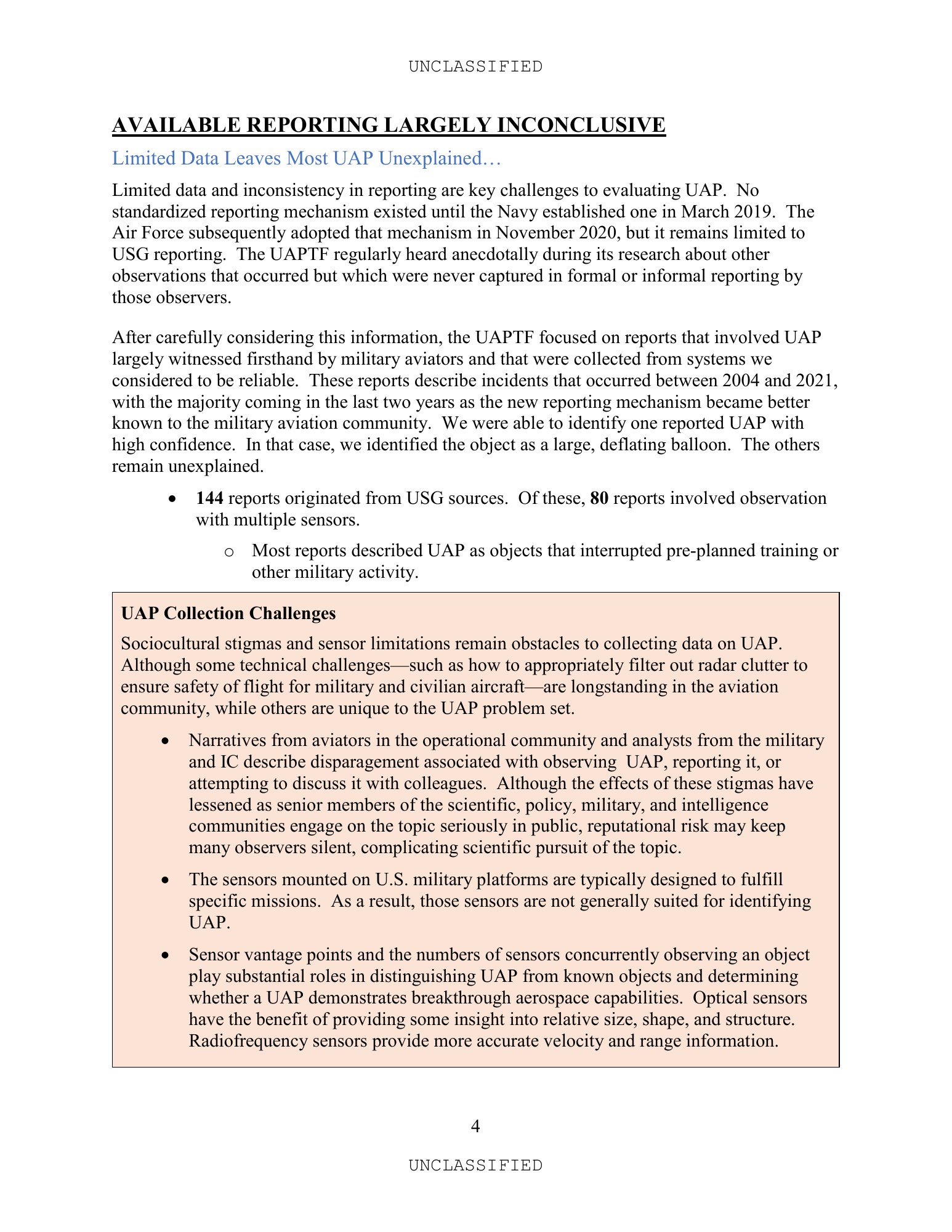
The June 2021 ODNI preliminary assessment covered 144 government reports, 80 involving multiple sensors. It identified one report with high confidence as a large deflating balloon. Eleven reports involved pilots reporting near misses. The assessment also warned that limited, inconsistent information hampered firm conclusions, and that some apparent unusual behavior could reflect sensor errors, spoofing, or misperception. 23
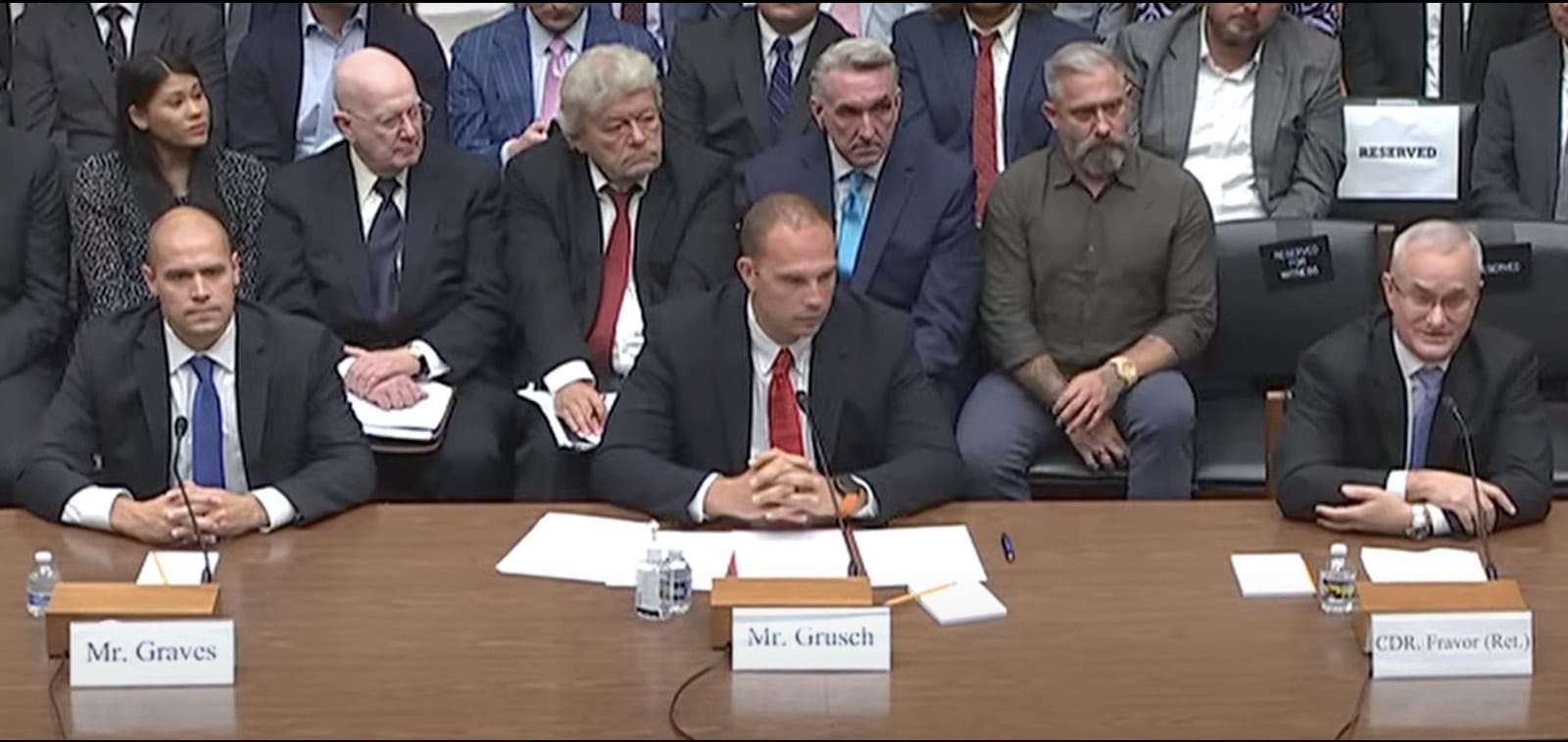
On July 26, 2023, Fravor and Graves testified at a House hearing alongside David Grusch. Their pilot accounts stand on their own; they do not depend on accepting separate crash-retrieval allegations. 24
Later AARO work has resolved cases as ordinary objects or effects while retaining others for analysis or leaving them unresolved for lack of data. Its FY2024 report said it had found no evidence of extraterrestrial beings, activity, or technology. The imagery catalog checked for this piece also contains newer unresolved military reports, including cases where the office says the available imagery cannot support a conclusive analysis. Neither a blanket dismissal nor a blanket alien explanation fits that mixed record. 1725
What the Military Record Actually Leaves Us
Military witnesses bring useful training. Military sensors can provide valuable measurements. Neither escapes uncertainty. A radar display needs technical context. A distant light needs a distance estimate. A recollection needs to be compared with the earliest available account.
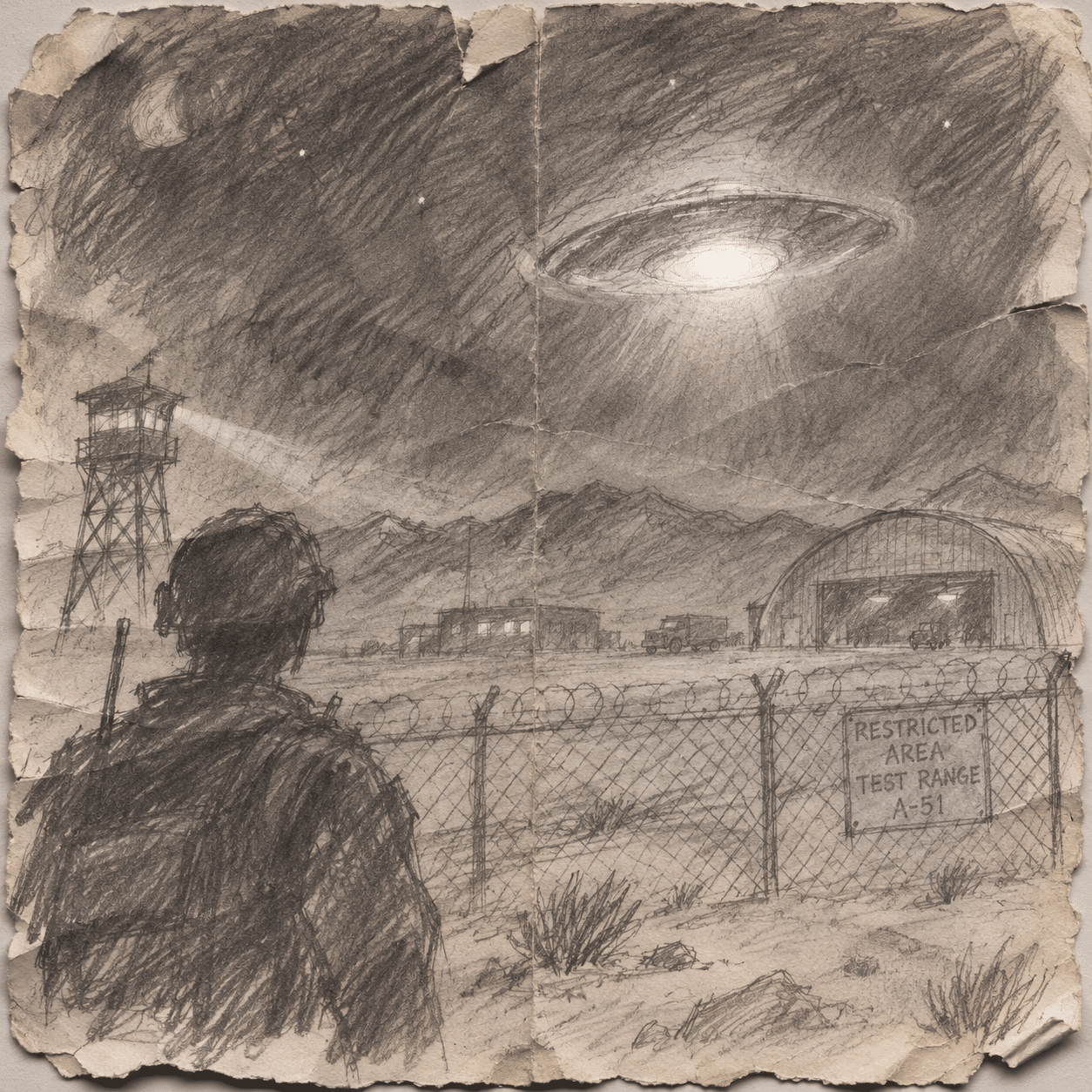
I keep coming back to the gap between the seriousness of the encounters and the incompleteness of what we can examine. At Washington, that gap sits between radar interpretation and visual reports. At Malmstrom, between a documented outage and an alleged cause. At Nimitz, between what aviators describe and what a short released video can establish.
Since starting Cryptic Chronicles in 2017, I’ve been drawn to stories that survive a second look. These encounters deserve that look, including the explanations that make them less spectacular. Pilots should be able to report a hazard without becoming a punch line, and readers should be allowed to remain curious without being handed certainty nobody has earned.
Somewhere above an ocean, beside a wartime aircraft, or beyond the lights of a runway, somebody saw something they couldn’t place. The next step should be a better record. I’d rather have that than another perfect story built around missing evidence.
Sources and Further Reading
- David Fravor’s written statement, House Oversight hearing, July 26, 2023.
- Smithsonian Air & Space: WWII foo fighters and the 415th Night Fighter Squadron.
- National Archives: 1952 Washington material in the Blue Book collection; historical overview and witness disputes.
- Civil Aeronautics Administration, A Preliminary Study of Unidentified Targets Observed on Air Traffic Control Radars, technical report transcription.
- National Archives: Project Blue Book records and Air Force fact sheet.
- RB-47 Blue Book case-file guide, with document scans and competing interpretations.
- Condon Report, Case 5: crew interviews, recording discrepancies, and conclusion.
- 341st Strategic Missile Wing histories, 1967–1968, USAF records released through FOIA.
- Robert Salas’s early published account and revisions to his reconstruction; later Oscar account distinguished from Echo documentation.
- 1976 Tehran defense-attaché report and DIA evaluation, transcription and scan links. The site’s commentary is separate from the reproduced government text.
- Summary of Klass’s Tehran explanation and the disputes around it.
- UK National Archives: Rendlesham correspondence and official response.
- Halt memo transcription and date discussion.
- Ian Ridpath’s Rendlesham investigation.
- Auguste Meessen: detailed analysis of the Belgian F-16 radar recordings (French).
- Stichting Skepsis: Petit-Rechain photographer’s 2011 hoax admission.
- AARO official UAP imagery, current case descriptions.
- Mick West: FLIR1 tracking analysis; Gimbal rotation and derotation analysis. These are skeptical interpretations, not official identifications.
- Ryan Graves’s written statement, House Oversight hearing, July 26, 2023.
- AARO case-resolution reports: GoFast, February 6, 2025.
- 2017 New York Times reporting on the Pentagon UFO effort; AARO Historical Record Report, Volume I, 2024.
- DoD statement on the official Navy-video release, April 27, 2020.
- ODNI preliminary UAP assessment, June 25, 2021.
- House Oversight: July 26, 2023 hearing and witness documents.
- FY2024 consolidated annual UAP report.
- The War Zone: airborne radar reflectors as one possible explanation.



0 Comments